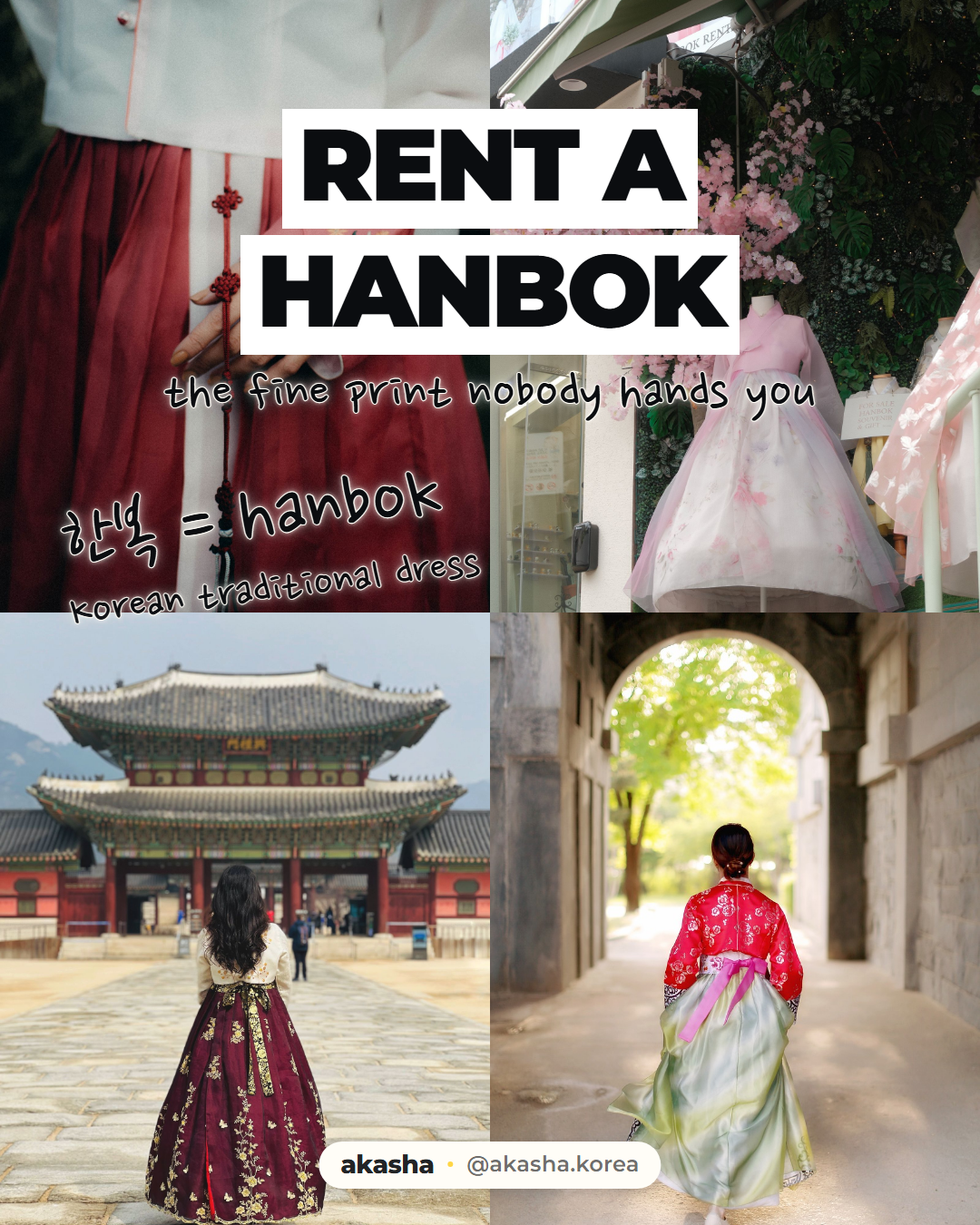
Rent a hanbok, Korea's traditional dress, for a day in Seoul. It is worn all over the streets around the palaces, the shops there hire it out by the hour or by the day, and wearing one gets you into the palaces free.
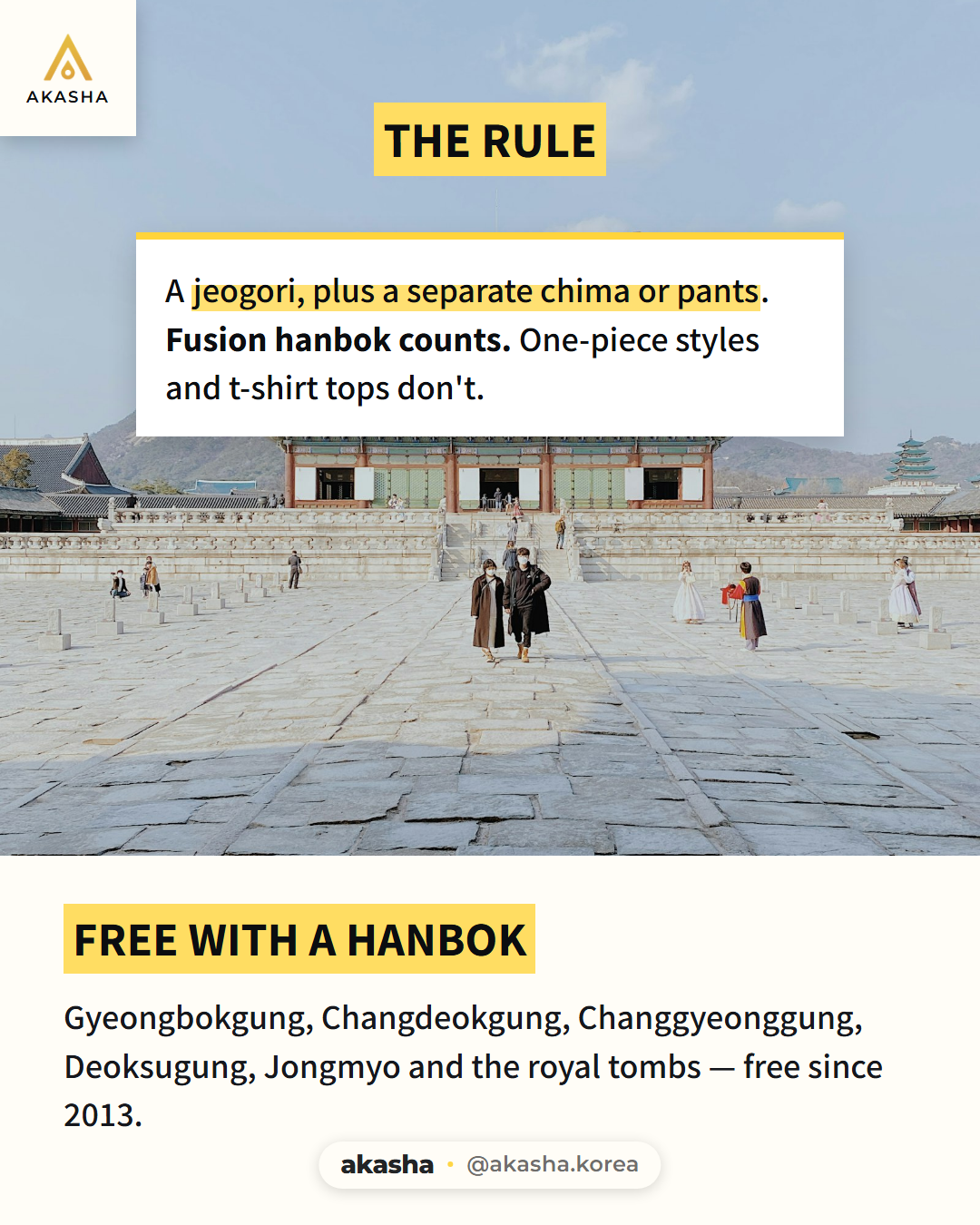
Before you pay, hold the outfit up and count the pieces. You want two: a jeogori, the short top with a collar that wraps across the chest, and a separate chima, the high-waisted skirt, or a separate pair of pants.
Two pieces, and Gyeongbokgung, Changdeokgung, Changgyeonggung, Deoksugung, Jongmyo Shrine and the Joseon Royal Tombs stop charging you at the gate. Changdeokgung's rear garden is the exception: it sells its own ticket and a hanbok does not cover it.
Counting takes ten seconds, and it is the one part of the day you can get wrong for money.
The scheme has run since 2013, year-round rather than only at holidays, and the Korea Heritage Service's palaces bureau publishes the qualifying standard itself, in Korean and in English. This rule applies on an ordinary Wednesday in March.
Check the day before you book the outfit. The closing days are split in two, and either one leaves part of the list behind a locked gate.
| Closed on | Sites |
|---|---|
| Tuesday | Gyeongbokgung · Jongmyo Shrine |
| Monday | Changdeokgung · Changgyeonggung · Deoksugung · Joseon Royal Tombs |
When a closing day falls on a public holiday they open anyway and close on the next non-holiday day instead.
Korea also opens the palaces free during Chuseok, with no clothing requirement at all. That is a different scheme and it gets confused with this one: what the holiday actually does to the city, and where to go while it does it.
Does fusion hanbok count?
Yes, and the published standard says so outright. It is also where a lot of the advice online has it backwards.
What gets charged at the gate is not fusion. It is failing the two-piece test, and those are not the same line.
| Outfit | Free entry? | Why |
|---|---|---|
| Modern or everyday hanbok with a wrapping collar | Yes | Two pieces |
| A man in a chima, a woman in baji | Yes | Gender is not part of the standard |
| Cheollik dress | No | Top and bottom arrive as one garment |
| Gollyongpo, the king's robe | No | Same |
| Palace guard's uniform | No | Same |
The bottom three are genuinely historical, and they still fail. All have been reported as charged.
Here is what actually fails:
- Jeans with a jeogori over them. The top alone isn't enough.
- A hanbok skirt or hanbok pants worn with a t-shirt. The bottom alone isn't enough either.
- One-piece styles where the top and the skirt are joined. Staff have to be able to see a jeogori and a chima as two separate components.
- A pull-on, t-shirt-style modern hanbok top, even with hanbok trousers under it. No wrapping collar, no qualifying top.
- A durumagi, the long outer coat, worn on its own.
Inside those two slots the standard is looser than people expect.
The Korean-language guidance says the jeogori needs the wrapping collar but not goreum ties to close it. The English page words that more strictly, so go by the Korean one. Pants qualify if they read as the traditional sapok cut, the panelled trouser shape, so a zip waistband and untied ankles are both fine. Skirts are barely restricted at all.
Since July 2019 the standard has been read without gender attached, so a man in a chima and a woman in baji both qualify, as Asiae reported in May 2026. Nationality is not part of it either: a visitor from Osaka is treated exactly like a resident of Jongno.
One line sits outside the two-piece test. The bureau reserves the right to turn away anyone dressed inappropriately, and the Korean page asks for clothing that suits the setting. That is the part nobody can check from home.
Which tells you what the check at the gate is for. The bureau describes the point of the scheme as getting hanbok worn more widely and more ordinarily, so a rule written for that will read the shape of the outfit rather than its pedigree. That is why a cheap modern set walks through while a one-piece robe with real history behind it gets charged.
One caveat on timing. The standard got argued about publicly in April and May 2026, after an actor's cheollik started a round of debate about how rigid it is, and the Korea Heritage Service reconfirmed it rather than loosening it. An official said a future revision might take in things like guard costumes, but as of late September 2026 no revision had happened. I'd treat the two-piece test as live.
Three words to say out loud at the counter
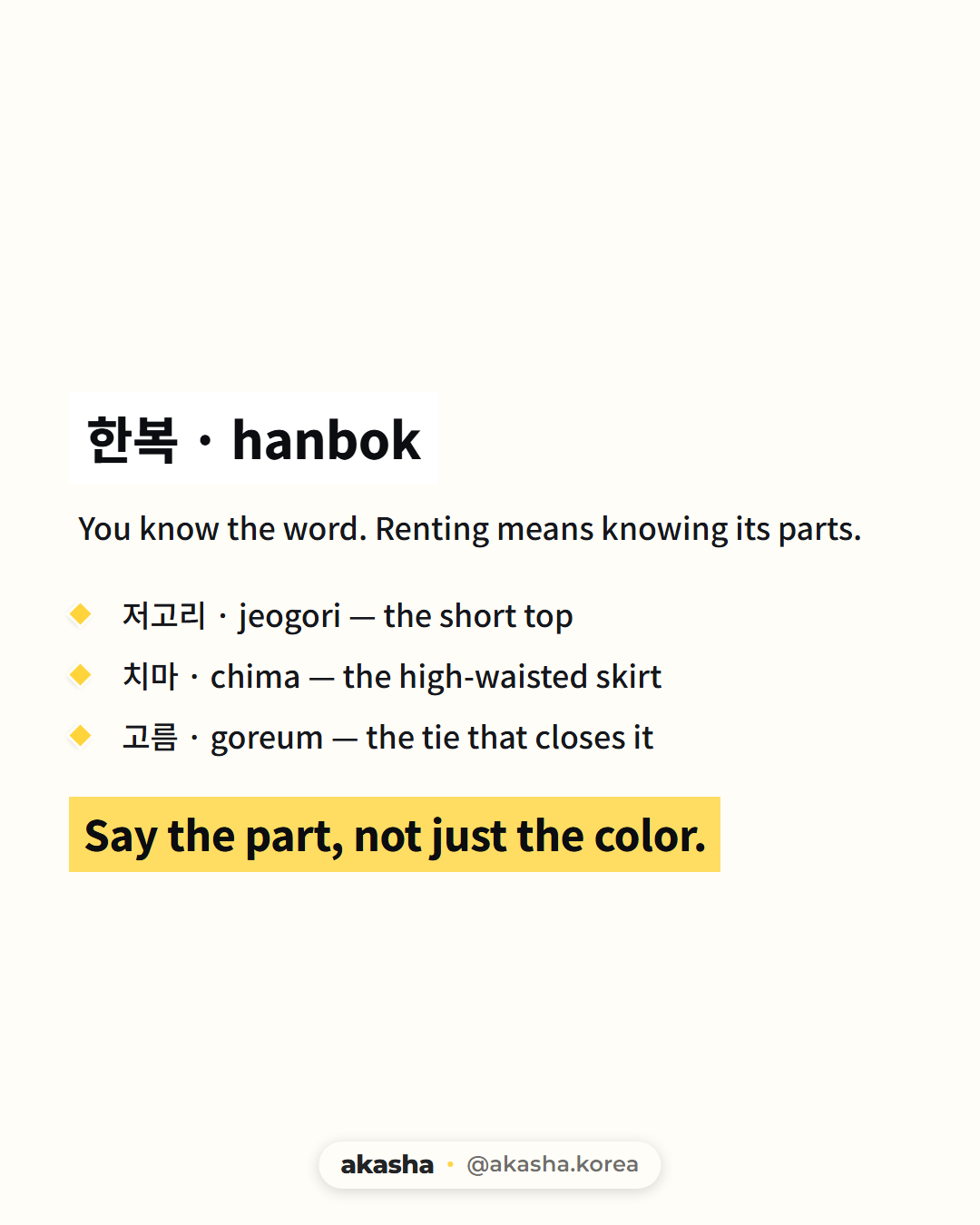
저고리 · jeogori is the short top. 치마 · chima is the high-waisted skirt. 고름 · goreum is the long tie that closes the jeogori in a loose bow.
Learn those three and the counting gets easier to do out loud. You can point at a rack and swap one piece instead of the whole outfit, and the rule becomes something you hear when it is spoken, because the standard is phrased in exactly these terms. When an assistant tells you the set is a jeogori and a chima, that sentence is the qualifying condition, not a description of the style.
Settle the time block before the colour
Shops rent in time blocks; some only do the full day. Both are normal. How many blocks there are, how long the short one runs, whether a half-day exists at all: that is a shop-level decision.
Rates rise with time while full-day rentals get discounted at certain slots. There is a fee, it moves with the outfit and with how long you keep it, and the shop's own rate board is the only number that matters.
My advice is to settle the block first. Colour will eat an hour if you let it, and an hour is a meaningful fraction of what you just paid for.
Hair styling is the line item to ask about
At some shops, flower shoes, daenggi ribbons, handbags, hair ornaments and hair styling all carry extra charges, and styling, accessories and vest rental are billed separately from the base rate.
At others, styling and accessories are part of what the shop provides. Ask which kind of shop you are in before you sit down in the chair.
There is a word trap sitting in the middle of it. Some shops advertise free hair accessories, meaning a ribbon and a few pins. That is not the same offer as somebody doing your hair. Ask which one is meant, in those words.
Akasha Note Two questions, in this order: which time block am I buying, and is hair styling inside the price or on top of it. Both answers are shop-level, and each one moves the total. Settling them before you are standing in a changing room is the whole point of asking. The two-piece test is the one part written down, which is why it is the one you can check from home.
Where the shops are
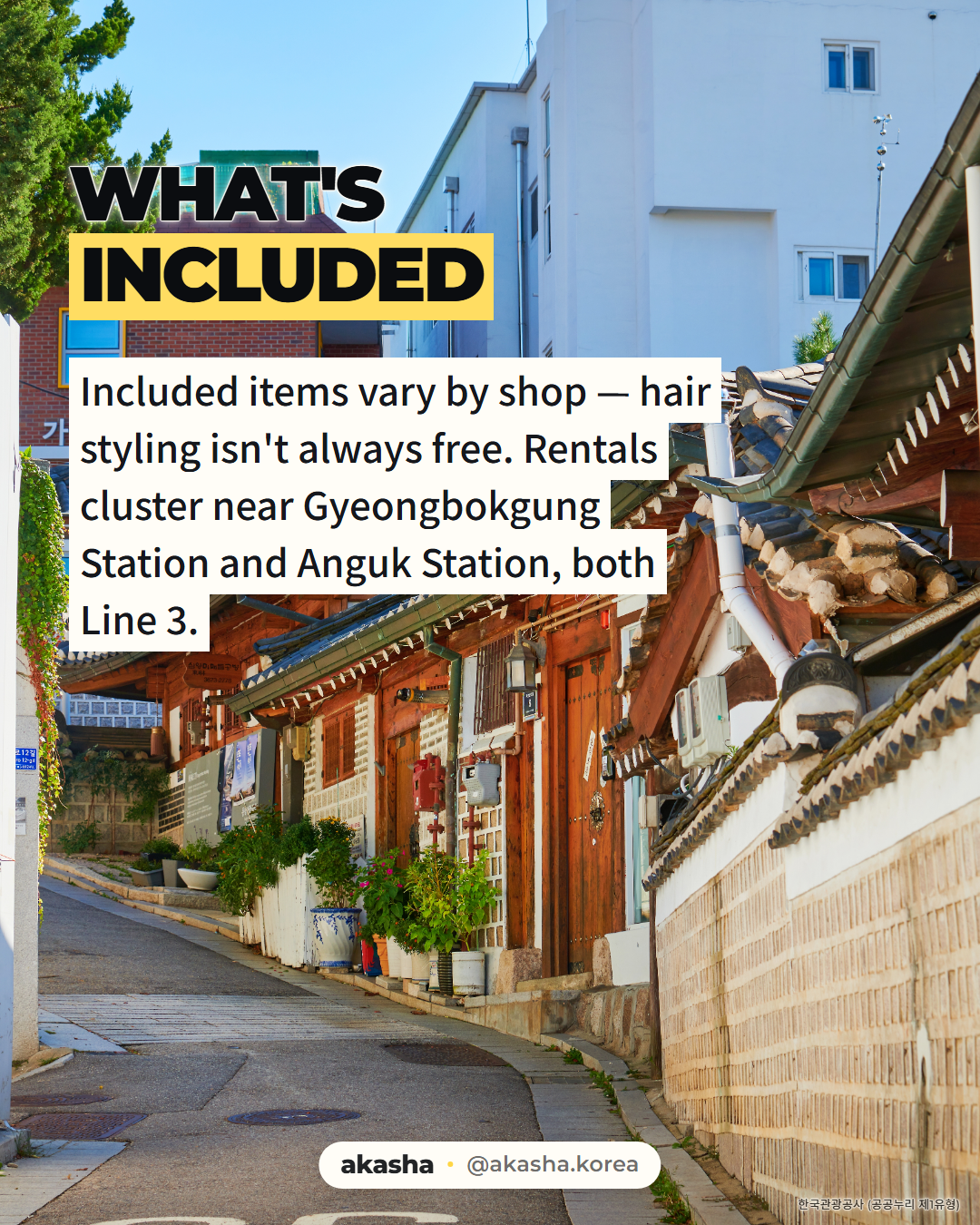
Two stations: Gyeongbokgung Station and Anguk Station, both on Line 3. Rental shops stand in front of Gyeongbokgung, with more of them through Anguk-dong and Samcheong-dong. Get off and look up.
Anguk is also the station for Bukchon, which has its own visiting rules worth knowing before you walk in with a camera. I compared it with Ikseondong down the road separately.
Before you go
- Count the pieces at the counter. A jeogori plus a separate chima or pants. Two, always.
- Mind the closing days. Gyeongbokgung and Jongmyo shut on Tuesdays; Changdeokgung, Changgyeonggung, Deoksugung and the royal tombs shut on Mondays.
- Fusion and modern hanbok qualify, as long as the top has a wrapping collar. One-piece styles, t-shirt-style tops, a durumagi worn alone, jeans with a jeogori and a hanbok skirt with a t-shirt do not. Cheollik dresses and other single-garment historical pieces have been reported as charged.
- It covers Gyeongbokgung, Changdeokgung (rear garden excluded), Changgyeonggung, Deoksugung, Jongmyo and the Joseon Royal Tombs, year-round since 2013. Men in a chima and women in baji qualify, and so do visitors from anywhere.
- Shops rent hourly and daily; the blocks are not standardised, so ask before you pay.
- Hair styling may or may not be included. Free hair accessories is a different offer from free styling.
Send this to whoever you are doing this with, ideally before one of you books something one-piece and gorgeous that gets charged at the gate. If your block ends before their train gets in, the seat I take when I am eating on my own will cover the gap.
Do it with a local Akasha, an app for finding local meetups and experiences in Korea, is where people list what's happening nearby on the day you're actually free, sound baths to Sunday hikes, alongside trips from registered Korean travel companies: iOS / Android
You can pass the two-piece test alone and walk through Gyeongbokgung's gate alone without paying a won. Then you are standing in a courtyard in an outfit built to be photographed, holding your own phone at arm's length.
One question for the comments, and I do read them: has anyone actually been turned away at a palace gate over what they were wearing, and what was the outfit?
Who wrote this. I run Akasha and write this blog from Seoul. I haven't rented a hanbok myself; the standard is published by the Korea Heritage Service (@chlove_u). More at @akasha.korea.
One card photo from Korea Tourism Organization, KOGL Type 1.