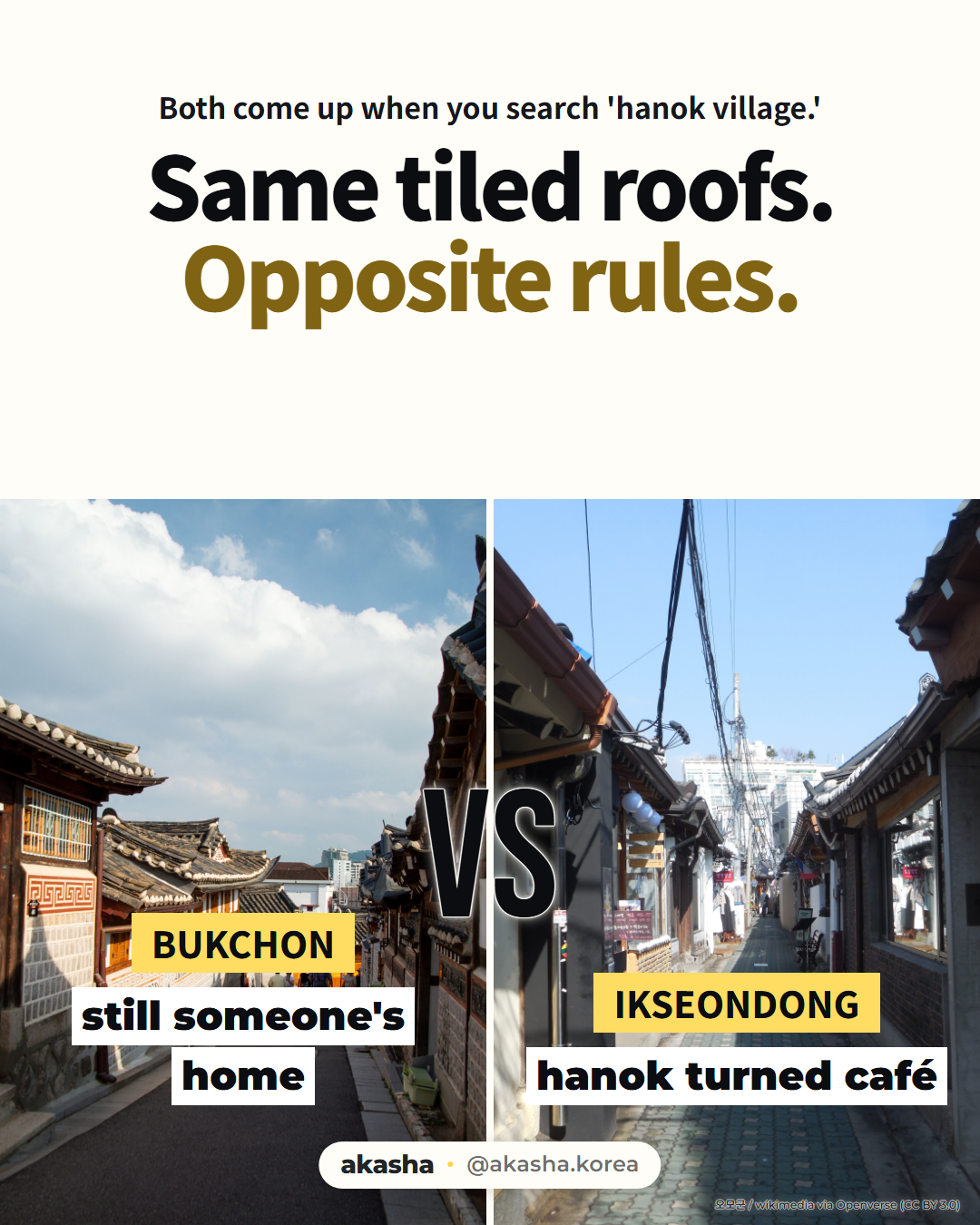
Search "Seoul hanok village" and you get both of these in the same page of results: Bukchon and Ikseondong, a short walk apart, both rows of tile-roofed houses. They are not the same kind of place. One still has people living behind those roofs, in numbers small enough that the city now limits when you can walk through with a camera. The other lost a fight with a demolition crew, and what's there now is cafés.
I've been to both. In both, what I did was walk into a café or a restaurant and sit down. That's a smaller claim than "I know these neighborhoods," and I want to be upfront about the gap it leaves, because it matters for one thing I'm about to tell you plainly: I have never seen Bukchon's visiting-hour rule in effect. No sign, no cutoff, no moment of being told to leave. It's real, and it's documented by the city, but it isn't part of what I personally experienced there.
So here's what this piece actually does: it explains why one of these neighborhoods has a curfew and the other doesn't, and then it gets to the part that matters more than either history: who you'd actually send to which one.
Why does one hanok village have a curfew and the other doesn't?
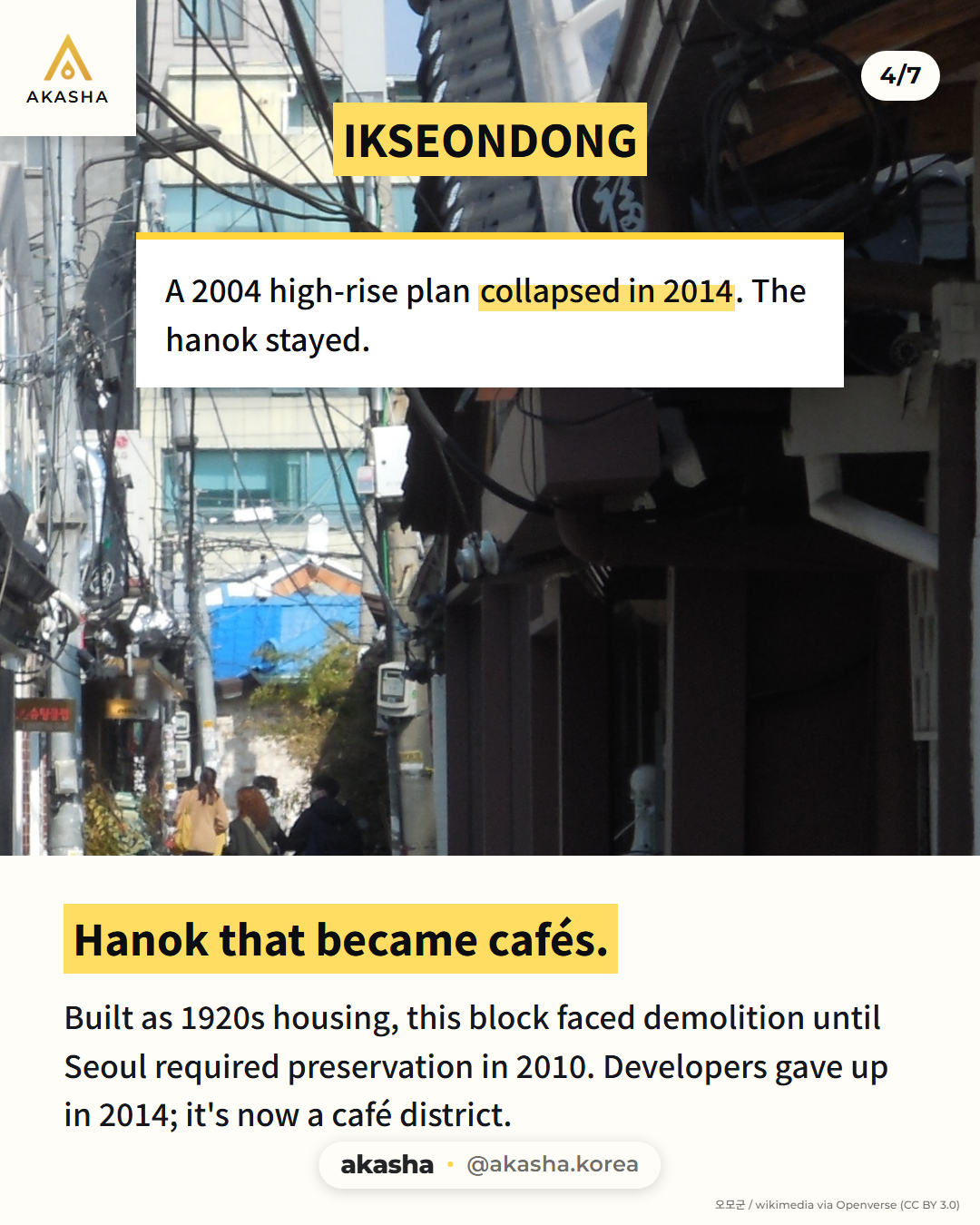
Bukchon's rule applies to one stretch, not the whole neighborhood: the Bukchon-ro 11-gil area, about 34,000 square meters, which Jongno District named a special tourism management zone, according to the Seoul Metropolitan Government's own media hub. Inside that zone, non-resident sightseeing is barred from 5pm to 10am. Jongno District's tourism platform spells out who's exempt from that window: registered residents and their families, shop customers, hanok-stay guests, merchants, and anyone just passing through without stopping to sightsee. The rule had a trial run from November 2024 to February 2025, then went to full enforcement, fine included, on March 1, 2025 — ₩100,000 for a tourism-purpose visit during the restricted hours, confirmed independently by both The Korea Herald and The Korea Times.
That Korea Times piece is worth reading past the headline. It ran the fix under one framing: restricting visits "to resolve overtourism." The same article puts Bukchon's registered population at around 6,100 as of the 2024 reporting, down 27.6% over the preceding five years, against roughly 6.4 million visitors the year before, in 2023. Those two numbers come from the same sentence but different years, which is exactly why I'm not folding them into one ratio here: a 2023 visitor count next to a 2024 resident count isn't a live snapshot of anything, just two different years that happen to share a paragraph. What they add up to, even kept separate, is a small residential population absorbing a lot of foot traffic, in a neighborhood that's mostly known for one thing: how it photographs.
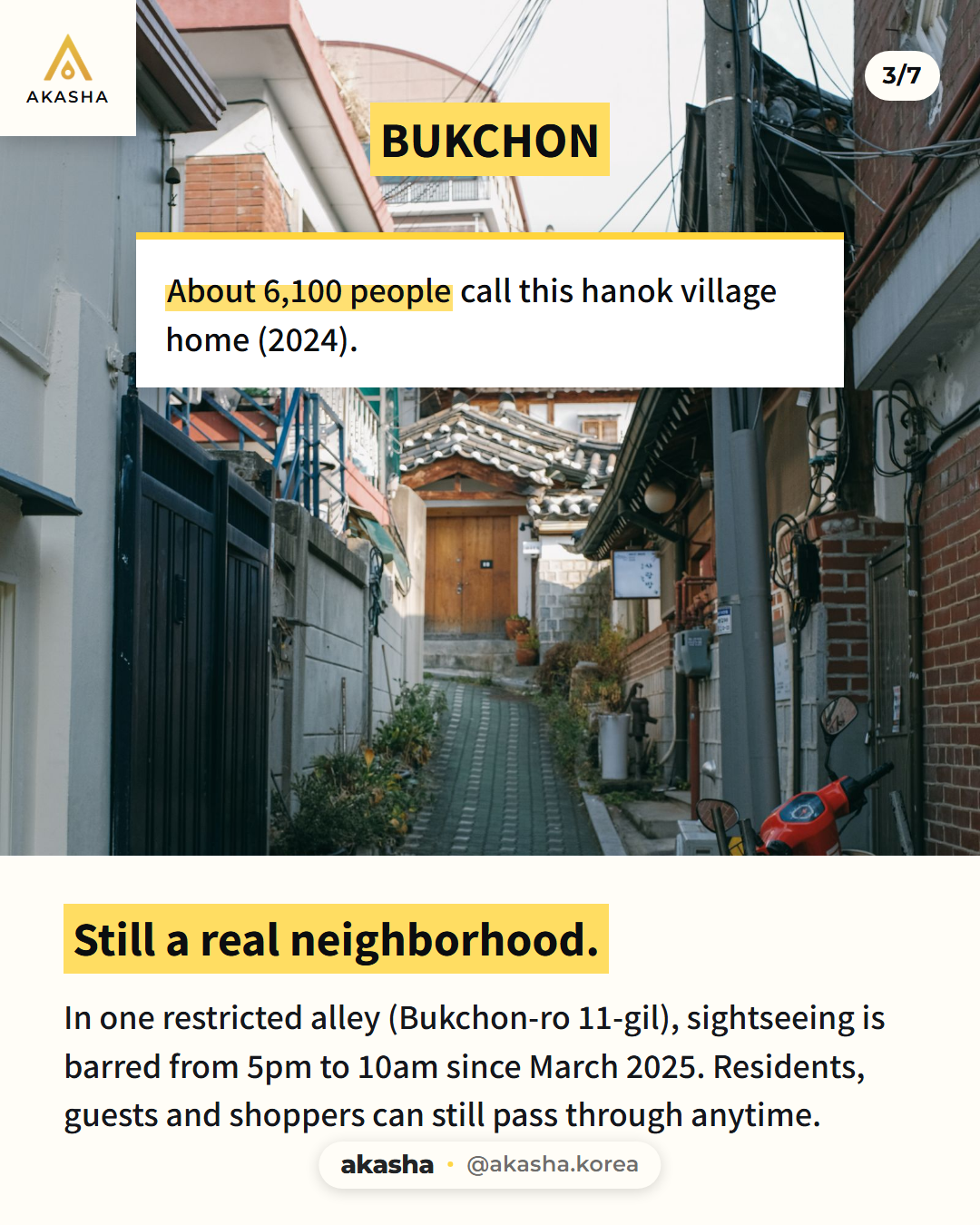
Ikseondong has no equivalent rule. I looked for one and didn't find it, which isn't the same as there not being one — but where Jongno's Bukchon page reads like it's protecting people who live there, Seoul's own hanok portal describes Ikseondong in terms of its cafés, restaurants and shops, not a resident population that needs a curfew to be left alone.
Ikseondong nearly became a fourteen-story building
The hanok in Ikseondong go back to the late 1920s and early 1930s, built by the developer Jeong Se-gwon, who subdivided land there (and in Bukchon) into small lots for small and mid-size hanok, part of an effort to keep Korean-occupied housing standing in central Seoul under Japanese colonial rule, according to the Seoul Metropolitan Government's official hanok portal. That's the same portal that lays out what almost happened to them: in April 2004, the area was designated for urban redevelopment, with a promotion committee planning a roughly 14-story mixed-use complex where the hanok stood.
It didn't happen. In October 2010, Seoul's City Planning Committee required the district plan to shift toward preserving the hanok rather than clearing them, and amid resident disagreement over that direction, the redevelopment committee dissolved itself in 2014. Seoul designated the area a hanok preservation and support zone in 2018. What I can't tell you is exactly when the cafés moved in. The official portal describes the outcome, not a start date for the commercial turn, so I'm not going to hand you a year that isn't in the record. What's confirmed is the shape of it: a demolition plan that lost, and hanok that stayed standing because of that loss, now filled with businesses instead of the apartment households that would have replaced them.
The honest gap in what I can tell you about Bukchon
Here's the tension I'm not going to smooth over: if someone tells me they're chasing photos, Bukchon is where I'd point them, and Bukchon is the neighborhood whose visiting-hour rule exists specifically because of the pressure that kind of visit puts on a place where people are trying to live. I'm not going to pretend that's a clean recommendation. It isn't.
What I can say is narrower than a verdict on the whole situation. What I did in Bukchon was walk into a café and sit down, the same as in Ikseondong. I didn't go at 6pm to test the rule, I didn't see a sign, and nobody asked me to leave. That's not the same as knowing how the enforcement actually plays out on the ground, and I'd rather tell you that plainly than describe a scene I didn't witness.
So which one do I actually send someone to?
This is the part the history doesn't answer by itself, and it's the reason I'm not going to hand you a ranking. It comes down to what the person wants that afternoon.
Bukchon is where I'd send someone who wants quiet, or whose whole reason for going is the photo. It's a place people still live, which is exactly why the hours matter and why walking through with a camera is a bigger deal there than it sounds.
Ikseondong is where I'd send someone who wants to sit down and stay a while, or whose reason for going is food. Nobody there is going to ask you to keep it down or watch the clock. That's the whole design of the place now.
Neither is the "real" one and neither is the "better" one — they're built for different afternoons. If you've only got a few hours and want both, the two are close enough to do on foot without needing an exact number of minutes between them.
Akasha Note Don't mix up which neighborhood you're standing in from the name alone — the names on a map don't tell you which one has people living behind those gates. If you see a posted schedule or hear about visiting hours, that's Bukchon's signal, not Ikseondong's.
Before you go
- Bukchon-ro 11-gil, the restricted stretch of Bukchon (not the whole neighborhood), bars tourism-purpose visits from 5pm to 10am, with a ₩100,000 fine, enforced since March 1, 2025. Residents, their guests, shop customers and hanok-stay guests are exempt.
- Ikseondong has no equivalent visiting-hour rule that I could find.
- I'm not naming individual Ikseondong cafés or shops here — the point of this piece is the neighborhood, not a specific storefront.
- Both are walkable from each other; don't plan around an exact minute count, just leave room in the day for both if you want them.
Send this to whoever you're trying to talk into one or the other.
If you're building the rest of that day around it, I've written about what actually happens on a templestay night, hour by hour, and about where I go, and which seat I take, when I'm eating alone — both useful for the stretch of a Seoul day that isn't spent deciding between two hanok neighborhoods.
Do it with a local Akasha, an app for finding local meetups and experiences in Korea, is where people list what's happening nearby once you've picked your neighborhood for the afternoon — sound baths to Sunday hikes, alongside trips from registered Korean travel companies: iOS / Android
Once you've picked a door to walk through, the next question is usually who's walking through it with you.

One question for the comments, and I do read them: which one did you walk into first, and did you know at the time which kind of hanok village you were standing in?
Who wrote this. I run Akasha and write this blog from Seoul. The Bukchon and Ikseondong parts are my own visits, cafés and restaurants, not a survey of either neighborhood. Facts checked 2026-09-24. More at @akasha.korea.