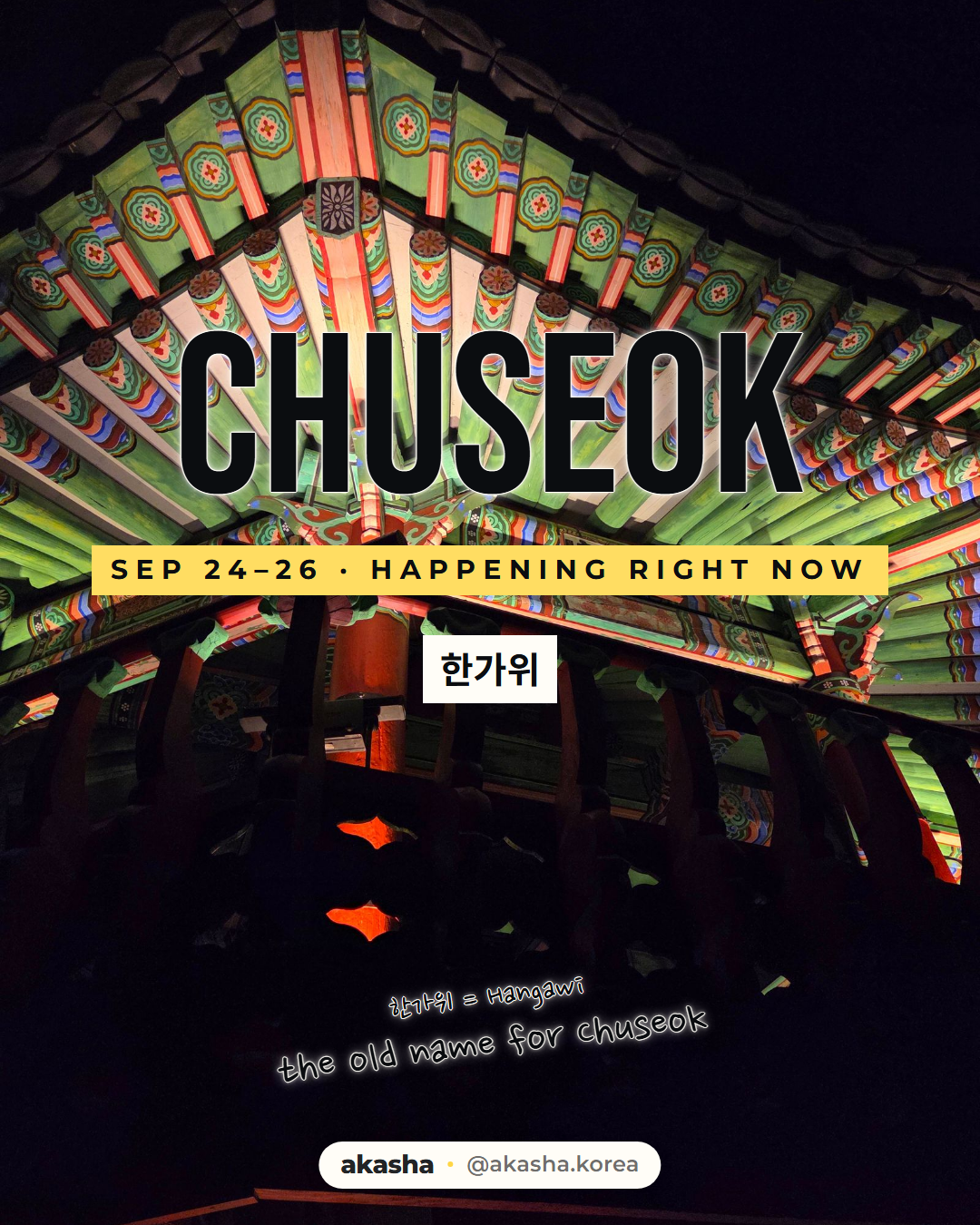
If you're in Korea right now and a lot of doors look shut, that's not a glitch in your trip. Today is Chuseok, the middle day of Korea's three-day holiday, and a good share of what's closed is closed for the same reason my own front door was locked earlier this morning: I was behind it, doing charye.
I'm not going to walk you through what that looked like. I'd rather stop there than invent a scene nobody asked me to describe. What I can do is something the Instagram cards couldn't: tell you about the door from the side I was actually standing on, then hand you the same facts everyone needs for the rest of today and tomorrow.
Here's the honest limit on that, too. I have never seen a foreigner in Korea during Chuseok, not this year and not before. So I'm not going to guess what your holiday looks like from where you're standing. I can only tell you what mine looked like from where I was, then hand off to what's actually running, closed, or free right now.
So where exactly are we in this holiday?
Today, September 25, 2026, is Chuseok itself: the actual date on the lunar calendar, not just a day that happens to fall inside the holiday around it. The official holiday runs three days, Thursday the 24th through Saturday the 26th. There's no extra day tacked on this year. Korea adds a substitute holiday only when the date would otherwise land on a Sunday or collide with another holiday, and September 26 does neither. Monday the 28th is a completely ordinary working day.
So: today is the middle day. Tomorrow is the last one. By Monday, it's over, and nobody treats it as a holiday hangover.
The doors that are actually shut, and the ones that aren't
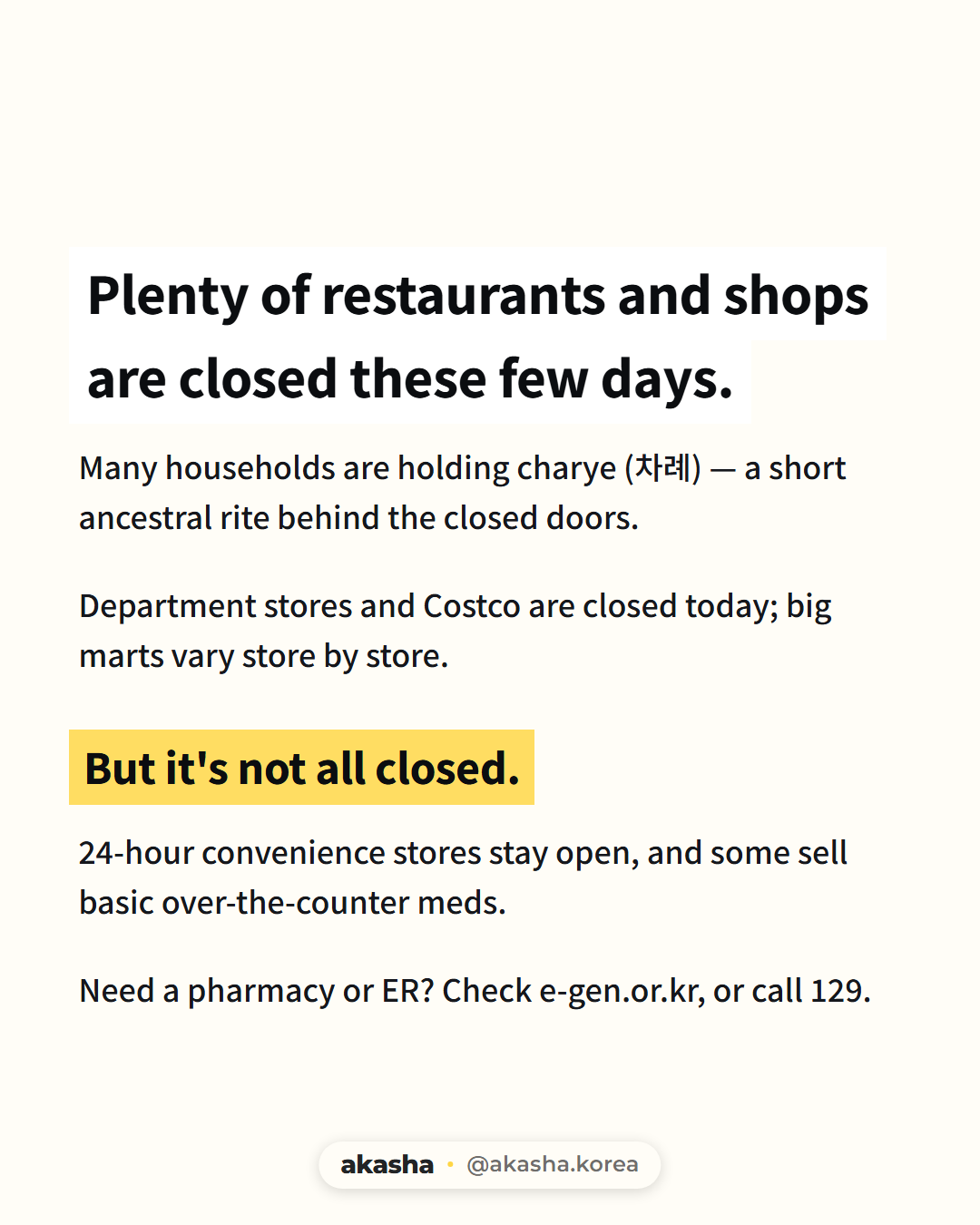
A lot of neighborhood restaurants and small shops are closed these few days, and charye is a large part of why. It's a short ancestral rite, held behind closed doors in a lot of households at once, mine included this morning. That's a quieter explanation than "randomly closed," even if it isn't a schedule you can look up.
Department stores and Costco are closed today. Big discount marts are inconsistent store by store, so don't assume either way about the one nearest you.
What stays open: convenience stores, round the clock, the way they always do. Some of them also sell a limited set of over-the-counter medicine: four categories, thirteen items total, things like pain relievers, cold medicine and antacids, capped at one box per person and not sold to anyone under twelve. If you need a pharmacy or an ER instead, don't wander looking for a lit-up sign. Check e-gen.or.kr, Korea's emergency medical portal, or call 129, and it'll point you to whichever one nearby is actually open today.
If the place you'd usually eat is dark tonight, eating alone somewhere else is a smaller problem than it looks. I've written separately about where I go and which seat I take when I'm eating on my own, and none of it depends on a restaurant you already had in mind being open.
If the holiday ends tomorrow, why does the free palace pass run through Sunday?
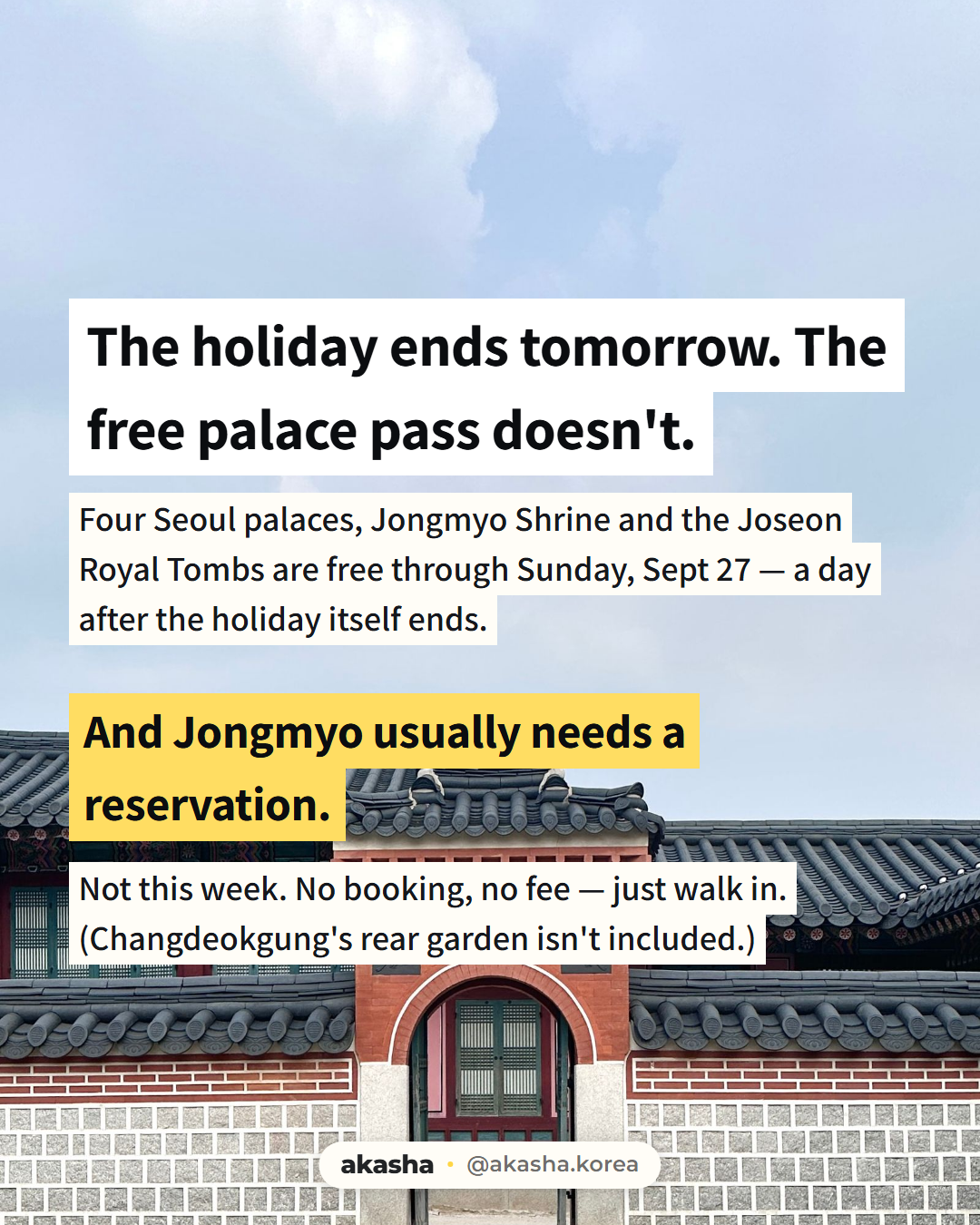
This is the one piece of this weekend that actually runs on two different clocks, and mixing them up is the easiest mistake to make. The statutory holiday, the three days everyone gets off work, ends tomorrow, Saturday. The free admission that Korea Heritage Service is running for Chuseok is a separate window, four days, Thursday through Sunday, one day longer than the holiday itself.
Inside that window: the four Seoul palaces, Jongmyo Shrine and the Joseon Royal Tombs are all free. Changdeokgung's rear garden isn't included; that one still charges and still needs its own ticket. Jongmyo normally requires booking a slot in advance; this week you can just walk in.
Akasha Note If you only have time for one of these, make it Jongmyo. It's the one place on this list you can't normally show up to without a reservation, and this week that requirement is simply gone. Go on a weekday morning if you can. Sunday is both the last day of free admission and the day everyone else figures that out too.
Two of the four free palaces sit a short walk from Bukchon, the hanok neighborhood with a visiting-hour rule of its own. If you're deciding where to spend the rest of the afternoon once you're out of a palace, I've written about how Bukchon compares to Ikseondong down the road: one is still a place people live, the other is cafés.
Why does everything feel quieter than usual?
A large share of the country is traveling to hometowns this week; this year's government forecast for the holiday period puts nationwide travel at an average of 11.82 million people a day. That's an average across the whole period, not a single day's peak, but it's still a lot of people leaving the cities behind for a few days.
If you're still around, that cuts the other way for you. Places that are usually packed have more room right now, palaces included. It won't last past the weekend.
What I'd actually do with what's left of today
Go see one of the free palaces before Sunday closes it out, Jongmyo especially, since the no-reservation part of that offer won't come around again soon. Don't count on finding songpyeon for sale today; I looked into it and couldn't confirm it's actually being sold anywhere in the city during the holiday itself, so I'm leaving that claim out rather than guess. And if you cross paths with anyone today, "즐거운 한가위 보내세요" is the greeting to use, happy Chuseok. You'll hear "되세요" just as often, but language commentators here have pointed out for years that a holiday is something you spend well, not something that happens to you, which makes "보내세요" the more careful version of the two.
Before you go, the short version:
- Today, Sept 25, is Chuseok itself. The holiday runs through tomorrow, Sept 26. Monday is a normal day.
- Department stores and Costco are closed today; big marts vary by store.
- Convenience stores stay open 24 hours; some sell a limited set of over-the-counter medicine.
- Need a pharmacy or ER? e-gen.or.kr or 129 will point you to one that's open.
- Four Seoul palaces, Jongmyo Shrine and the Joseon Royal Tombs are free through Sunday, Sept 27, a day past the holiday itself. Changdeokgung's rear garden isn't included. Jongmyo needs no reservation this week.
- Streets and palaces alike have more room than usual, because a large share of the country is traveling.
Do it with a local Akasha, an app for finding local meetups and experiences in Korea, is where people list what's running once the holiday itself is over too — sound baths, Sunday hikes, the kind of thing that doesn't stop just because a shop's shutters do: iOS / Android
Whoever else is in Korea with you right now, this is the one to send them before today's over rather than after.
Once the holiday's behind you and the shutters are back up, the next question is usually who you'd want to explore the reopened city with.
One question for the comments, and I do read them: what have you found open today that you didn't expect to be?
Who wrote this. I run Akasha and write this blog from Seoul. The charye part of this piece is mine; I'm not describing anyone else's. Facts checked 2026-09-25. More at @akasha.korea.