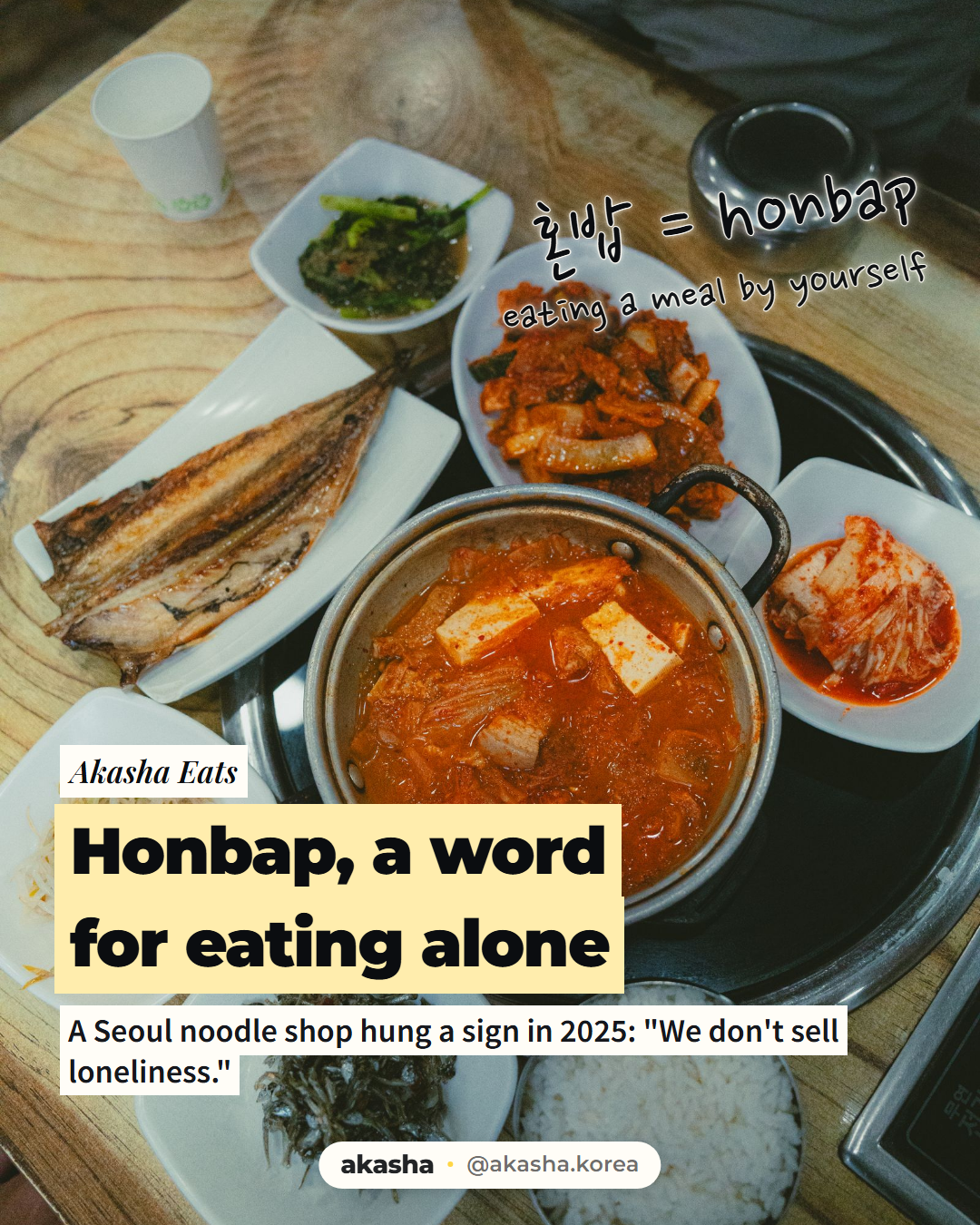
Eating alone in Korea has a word for it, honbap, and most days it is unremarkable. The friction you have read about is real, but it is narrower than the search results make it sound, and it is not the thing that stops people. What stops people is the doorway: the half second where you look in, count the tables, and decide you are not doing this tonight.
So here is what I actually do, and it is two decisions rather than one. I choose the kind of shop before I leave the house. Then, once I am inside, I take the counter.
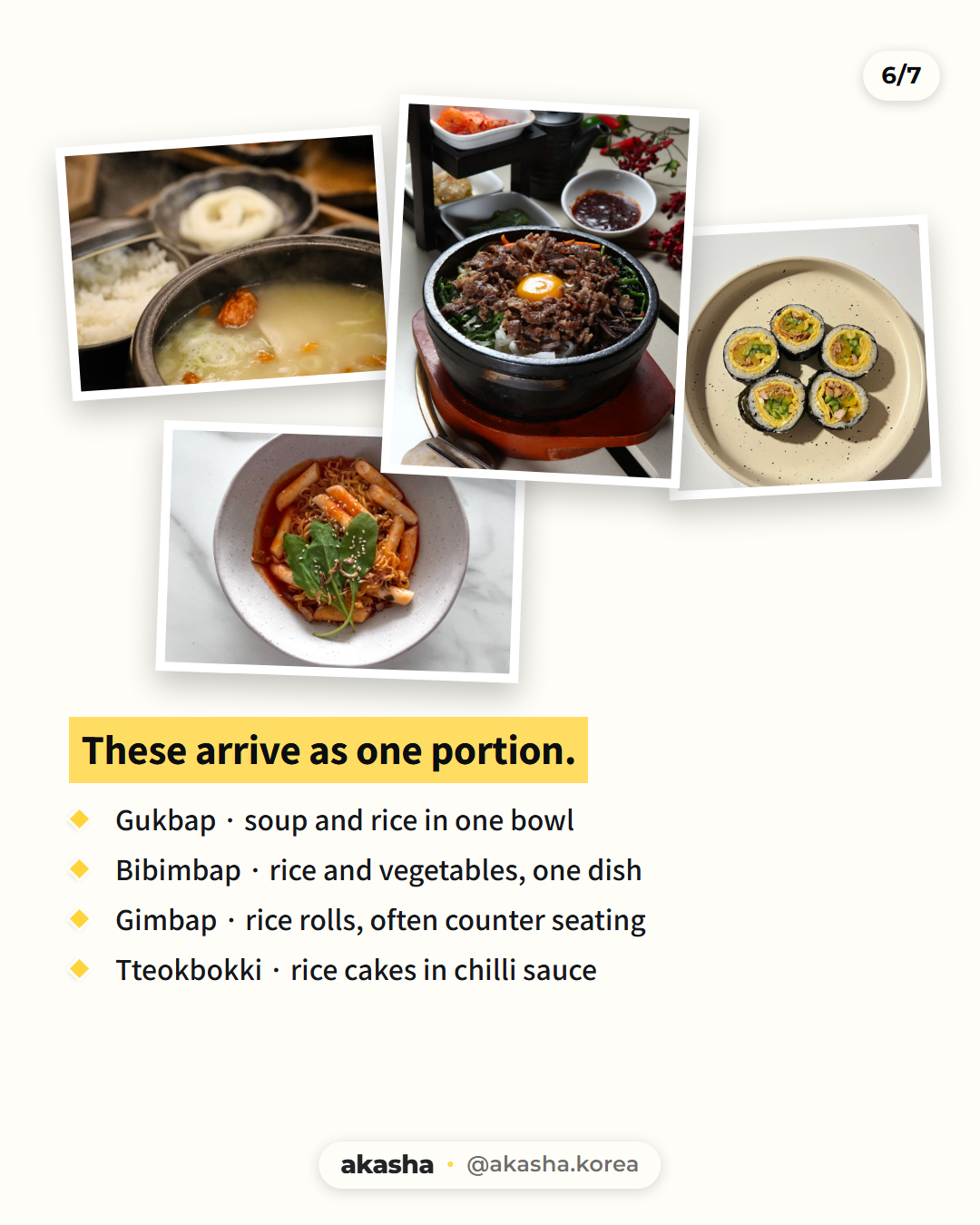
Neither of those is brave. My solo list is short and fairly dull: gimbap, tteokbokki, guksu, ramyeon. Rice rolls, rice cakes in chilli sauce, noodles in broth, instant noodles cooked at the shop. The Korean word for that whole category is bunsik, and I did not arrive at it through research. I arrived at it because those are the places I keep going back to on my own.
This piece is about why that list works, why the seat matters more than the shop, and what the numbers say is happening to everyone else who eats alone here.
Can you just walk in alone?
Almost always, yes. And I want to be precise about the exceptions, because vague warnings are what keep people ordering delivery in a hotel room.
What is documented is specific, dated and small in number. In May 2026 Yonhap, Korea's national news agency, ran a segment in which reporters phoned one hundred restaurants asking whether one person could be seated for lunch. They found cases where a solo diner was refused, and cases where offering to pay for two portions still did not get a table. A precise rejection count from that segment circulates widely online. I could not open a version of the report that showed it, so it is not in this article. The method and the finding stand; the number does not.
Alongside that, there is a restaurant sign from late 2025 and a CNN Travel writer who was turned away twice. Both were reported in English. I put those on Instagram card by card rather than here, because what they give you is a feeling, not an instruction. More in 60 seconds on Instagram.
I would love to tell you the friction maps neatly onto dish categories, so that you could memorise a safe list and stop worrying. It does not. The sign that made English-language news went up in a noodle shop, which is exactly the category I would have called safe.
One more thing worth knowing before you go looking for it: there is no official rule. I checked the English pages of Visit Seoul, the Korea Tourism Organization and the Seoul Metropolitan Government on 2026-09-24 for anything documenting a two-portion minimum, and found nothing. When a place turns you away, you are meeting one owner's policy on one night, not a national convention with a published text behind it.
Send this to whoever you are travelling with, especially if they are the one who says "let's just get something back at the room."
Where I go when I eat alone
The useful part of my list is not the dishes. It is that the list exists at all.
I do not stand on a street deciding where to eat alone. That decision was made a long time ago and it does not get remade at the door, which is the exact moment the nerve goes. Gimbap, tteokbokki, guksu, ramyeon. Four things, and any street in a residential neighbourhood has all four.
Why those, when I think about it afterwards: they are built as one serving. Nobody has to portion anything for you, nothing arrives on a shared grill or in a pot meant for the middle of a table, and the kitchen is not doing anything unusual by feeding one person. There is no adjustment to request, which means there is no conversation to have in a language you may not speak.
Seoul now also has one-burner BBQ rooms and franchises built on single servings, and that is genuinely new. It is not my list. Mine stays small on purpose, because a short list is what makes the decision cheap.
Take the counter seat
This is the one piece of advice in this article that I would fight for.
When I eat alone, I sit at the counter or the bar. If there is a row of seats facing the kitchen, or a shelf along the window, that is where I go, even when the room is empty and I could have any table I want.
Two reasons, and they are different reasons.
The first is about you. At a two-person table, there is a chair facing you with nobody in it, and that empty chair does a lot of work on a person's nerves. At a counter you are facing a wall, a kitchen, or a pass with bowls coming over it. There is nothing opposite you to be conspicuously empty. The room reads you as a customer eating, rather than as someone whose friend has not turned up.
The second is about the shop, and it is the part I have never seen written down. A two-top held by one person is a seat the shop cannot sell during a rush. A counter seat is one seat wide by design; nobody built it expecting a pair. So taking the counter is not modesty, it is simply using the thing that was made for the situation you are in. I have never had an owner say any of this to me. It is my read on how the room works, not anybody's stated policy, and I would still bet on it.
The side effect is that everything gets shorter. Order, food lands in front of you, done. No crossing the room, no reaching over an empty place setting.
Akasha Note Before you go, look at the photos on the listing rather than the reviews. If you can see a counter, a bar along the kitchen, or a window shelf with stools, you already know where you are sitting and roughly how the room will feel. That tells me more about whether I will be comfortable alone than any star rating does.
48.5%, and what that number is admitting
The headline figure this year came from CatchTable, a Korean restaurant reservation and waiting-list platform: solo bookings up 38.1%. I used that one on Instagram. The number I kept turning over afterwards was a different one from the same release.
CatchTable published its "2026 Solo Dining Trends" report from its own app data, comparing January to July 2026 with the same months a year earlier. Reservations by one person were up 38.1%. Solo entries onto restaurant waiting lists were up 48.5%. Searches for "honbap" on the platform were up 139.1% in January 2026 alone, its highest on record, and buffet bookings for one in July 2026 were up 216% year on year.
A reservation is private. You book from your phone, you arrive, the seat has your name on it. Putting yourself on a waiting list is not private at all: you stand there, visibly one person, in front of everyone else who is waiting in twos and fours, and you keep standing there. That is the number that rose faster.
Worth saying clearly: this is one company's booking data, not a census, and it only sees restaurants that use that platform. Treat it as a direction of travel rather than a measurement of the country.
Looking a place up before you walk in
Here I have to disappoint you slightly, because the neat answer does not survive checking.
Naver, whose maps and place listings are what people here actually use, replaced star ratings with a keyword review system in October 2021, first for ten business categories including restaurants. Diners pick keywords instead of scoring out of five. One of those keywords, for restaurants, translates as "good for eating alone."
That is a crowd-sourced tag sitting on a place's page, not a search filter you can switch on. I could only find the keyword itself attested on a secondary reference site rather than an official Naver page, and I could not confirm it appears at all in the English interface. So do not fly in expecting to filter a map for solo-friendly restaurants. If you see the tag, it is a real signal left by real diners. If you do not see it, that tells you nothing.
Which is why I fall back on the photos, and on the counter.
Before you walk in: the short version
Save this before you fly.
- Decide the category at home, not at the door. Mine is bunsik and noodle shops: gimbap, tteokbokki, guksu, ramyeon.
- Prefer dishes that arrive as one serving, with nothing shared in the middle of the table.
- Open the listing photos and look for a counter, a bar or a window shelf.
- Inside, take the counter seat even if tables are free.
- If a shop turns you away, that is that shop's policy. No official English-language page from Visit Seoul, the Korea Tourism Organization or the Seoul city government documents a two-portion rule, checked 2026-09-24.
- Solo grill formats and one-person franchises exist in Seoul and have been expanding since 2022. A different evening from a bowl of noodles, and worth knowing the option is there.
If you like having the contingencies covered, I have written separately about the three numbers worth saving before you land.
Do it with a local Some nights the point is eating alone. Other nights you would rather be in a room with people and no responsibility for making the plan. Akasha, an app for finding local meetups and experiences in Korea, is where those are listed: meetups, workshops, wellness sessions and local tours, alongside trips from registered Korean travel companies. What is running near you on a given week depends on who is hosting: iOS / Android
The one Korean meal where nobody eats alone
There is a meal here that runs on the opposite logic, and it is worth putting next to honbap because the contrast explains both.
On a templestay, meals are taken together, in silence, from a nested set of wooden bowls. Everyone in the hall is doing the same thing at the same moment, nobody is talking, and the question of who you came with never arises. It is company without conversation. I wrote about how one of those nights actually runs, hour by hour, from the official 2026 schedules.
A counter seat at a noodle shop gives you a version of the same thing on a Tuesday. You are not hiding, and you are not performing company either. You are just one of the people eating.
Once eating alone stops being the hard part
The reason to get good at this is not self-sufficiency. It is that once the doorway stops being a decision, your evenings open up, and the next question changes from "can I go in alone" to "who would I want across the table."
That second question is the one Akasha is built for. Browse what people are hosting while you are here, from meetups and workshops to local tours and wellness sessions, and pick an evening you would not have planned on your own.
One question for the comments, and I read them: what was the first thing you ate alone in Korea, and did you take a table or the counter?
Who wrote this. I run Akasha and write this blog from Seoul. The honbap parts are my own habit, not an endorsement — Akasha does not run or recommend restaurants. Facts checked 2026-09-24. More at @akasha.korea.