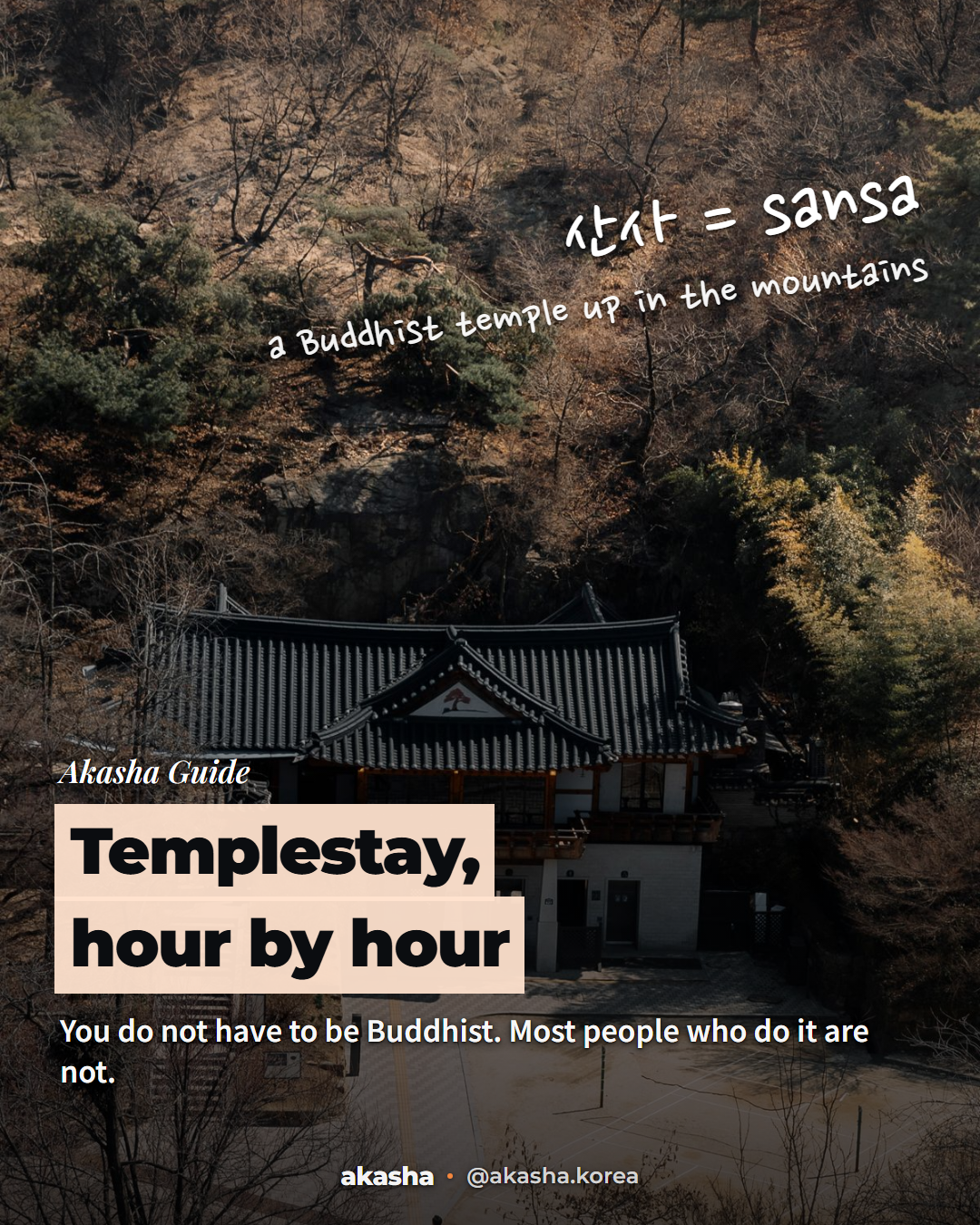
A one-night templestay in Korea costs roughly ₩60,000 to ₩100,000. It checks you in during the early afternoon, feeds you dinner before six, turns the lights out at nine, and wakes you somewhere between 3:30 and 5:15 for a chanted service held in the dark. None of that is dramatised. It sits in published timetables, printed the way train departures are printed.
I've done templestay at several Korean temples, not all of them in the mountains. One of my stays was at a city temple you reach by subway, and the wake-up time was no gentler for it. The part that stayed with me isn't the food, or the room.
It's the alarm.
I set it myself, on my own phone, the night before. I didn't wait for a bell or a knock on the door, and the reason is easy enough to admit: I didn't want to be the person who walked into the hall late. That small dread was already there at lights-out, hours before anything was due to happen.
So: four official 2026 schedules hour by hour, what those early hours are actually for, what you can skip, what it costs, and who I'd tell not to book it.
First: "templestay" is not one thing
The program is run by the Cultural Corps of Korean Buddhism, an affiliate of the Jogye Order. In 2025 it operated at 158 temples across the country and drew 349,219 participants, 55,515 of them foreign visitors, up 5.1% on the year before and the highest figure on record. Foreign participation has more than doubled since 2022, when it was 26,587.
The English program list sorts every listing into one of three named types, and this is the part the short formats never have room for:
| Type | What it means |
|---|---|
| Experience-oriented | A structured program. Orientation, temple tour, services, and activities such as meditation or bead-making are scheduled for you. |
| Rest-oriented | The official Korean-language site defines it plainly: you are free outside the scheduled Buddhist services and meals. Those two things are the only fixed items. |
| One-day | No overnight stay at all. |
Overnight is the format people picture, but it isn't the only door in. Golgulsa runs a daytime program at ₩80,000; Bongeunsa in Seoul has a ₩5,000 drop-in pass. At the other end, the Lotus Lantern International Meditation Center lists a three-night Seon retreat over Chuseok at ₩210,000 sharing, ₩360,000 single.
The same temple can often be booked either way. Beomeosa, Beopjusa and Hwagyesa each run both types. Hwagyesa's rest listing is called "Only Rest [Relaxation Program]," described on its temple page as two Buddhist ceremonies, two meals and accommodation, without other fixed activities. That's the whole product. If it sounds thin, it's meant to.
And because people ask: most participants aren't Buddhist. In a participant survey with 27,563 respondents, 9,295 of them (33.7%) identified as Buddhist; among foreign participants, 43.4% reported no religion at all.
The night, hour by hour
Below are the four official 2026 schedules as published. I have kept each temple separate on purpose. There is no national timetable, and blending them into one tidy "typical day" would invent a temple that does not exist.
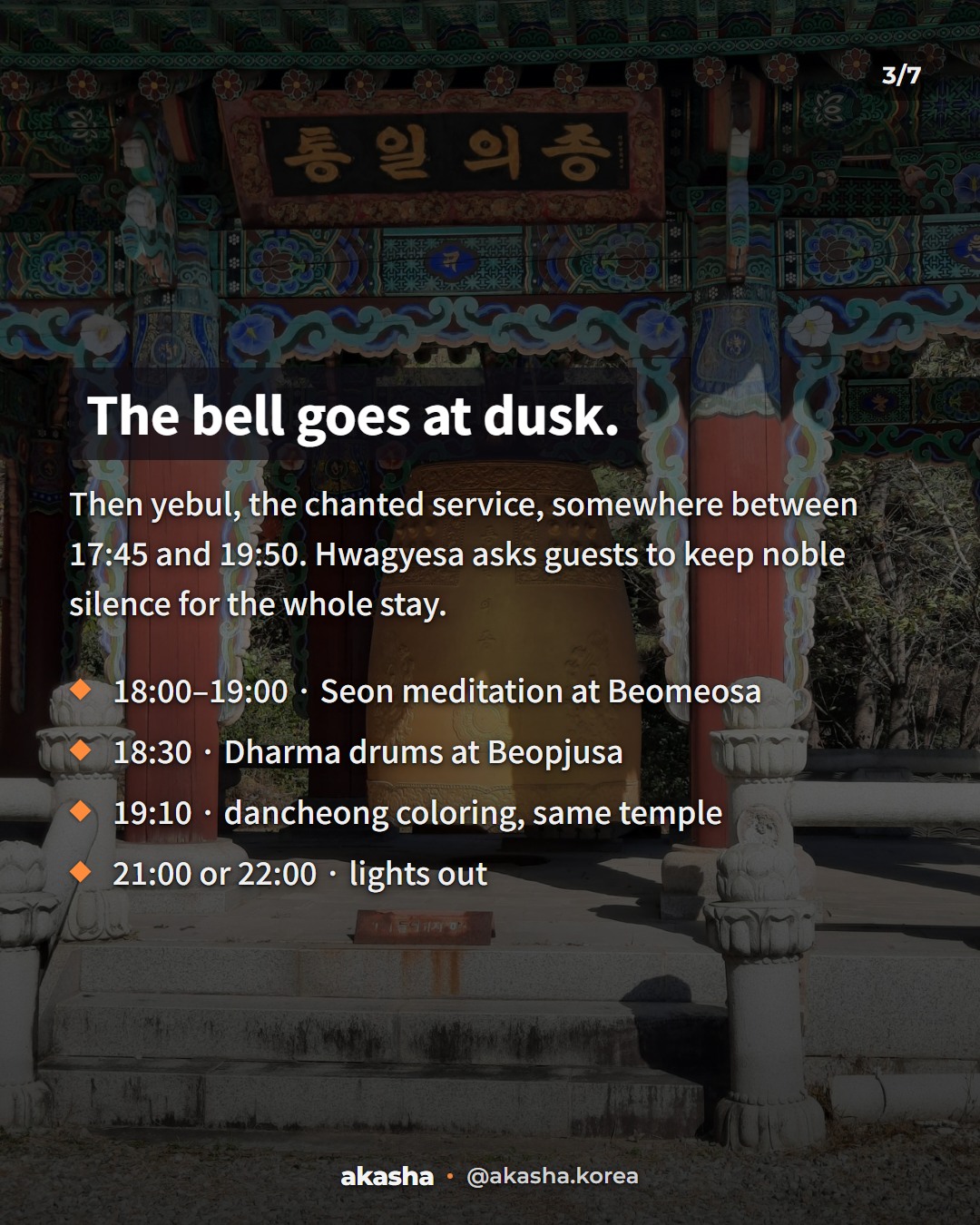
Hwagyesa, Seoul, at the foot of Bukhansan. "2026 GangBuk Wellness Templestay (1N2D)," experience-oriented, ₩90,000 per adult.
| Day 1 | Day 2 | ||
|---|---|---|---|
| 13:20–14:00 | orientation | 05:15–05:40 | morning chanting |
| 14:00–15:30 | temple tour | 05:40–06:30 | meditation |
| 16:00–17:00 | dinner | 06:30–07:20 | breakfast |
| 17:45–18:20 | ringing the big bell, evening chanting | 07:20–08:30 | free walk on the Dullegil |
| 18:20–19:30 | making 108 beads / coloring an ecobag | 09:00–10:20 | tea with a sunim |
| 22:00 | lights out | 10:30–10:40 | departure |
Beomeosa, Busan. Experiential Templestay (weekends), ₩100,000 per adult per night.
| Day 1 | Day 2 | ||
|---|---|---|---|
| 13:00–14:00 | check-in | 03:30–04:50 | individual wake-up |
| 14:10–15:10 | orientation | 04:30–05:30 | morning ceremony (optional) |
| 15:10–16:50 | temple tour, forest walking | 07:00–07:30 | breakfast offering |
| 17:00–18:00 | dinner offering | 08:30–09:30 | tea time, Q&A |
| 18:00–19:00 | Seon meditation | 09:30–10:00 | check-out |
| 19:00–20:00 | stringing 108 prayer beads | ||
| 22:00–00:00 | sleeping |
Beopjusa, Songnisan, Boeun, North Chungcheong. UNESCO-listed. Weekend experience program, ₩100,000 per adult (₩130,000 with single-room supplement).
| Day 1 | Day 2 | ||
|---|---|---|---|
| 15:00–16:00 | arrival, accommodation | 04:00–04:20 | wake up |
| 16:30–17:00 | orientation | 04:30–05:00 | early morning ceremony |
| 17:00–17:30 | cultural heritage tour | 05:00–05:40 | 108 prostrations, bead making |
| 17:30–18:00 | dinner | 06:00–06:30 | breakfast |
| 18:30–18:45 | sound meditation with Dharma drums | 06:30–08:30 | free time |
| 18:45–19:00 | Buddhist ceremony | 08:30–10:30 | walking meditation, Sujeongbong peak or King Sejo's road |
| 19:10–20:10 | dancheong coloring meditation | 11:00–12:00 | lunch, check-out |
| 20:10–21:00 | free time | ||
| 21:00–04:00 | sleep |
Mihwangsa, Haenam, South Jeolla. Rest-oriented, ₩100,000 per adult, ₩80,000 teen and child.
| Day 1 | Day 2 | ||
|---|---|---|---|
| 15:00–16:00 | check-in | 04:30 | wake up |
| 16:00–17:30 | personal time | 05:00–05:30 | morning prayer |
| 17:30–18:00 | dinner | 05:30–07:00 | personal time |
| 18:15–18:30 | bell ringing | 07:00–07:30 | breakfast |
| 18:30–19:50 | evening prayer service | 08:00–08:40 | temple sweeping |
| 19:50–20:30 | evening viewing and reflection | 09:00–09:30 | coffee time |
| 21:00–04:30 | sleep | 09:30–10:00 | tidying the room |
| 10:00–10:30 | check-out |
The shape underneath all four. Check-in lands between 13:00 and 16:00. Dinner is between 16:00 and 18:00, hours earlier than most visitors expect to eat. Evening chanting, with bell or drum, falls between 17:45 and 19:50, and lights go out at 21:00 or 22:00. Wake-up is between 03:30 and 05:15, morning chanting between 04:30 and 05:40, breakfast between 06:00 and 07:30, check-out between 09:30 and 12:00.
Read the evening again. The day ends around the time you would normally be leaving a restaurant. Save this before you fly.
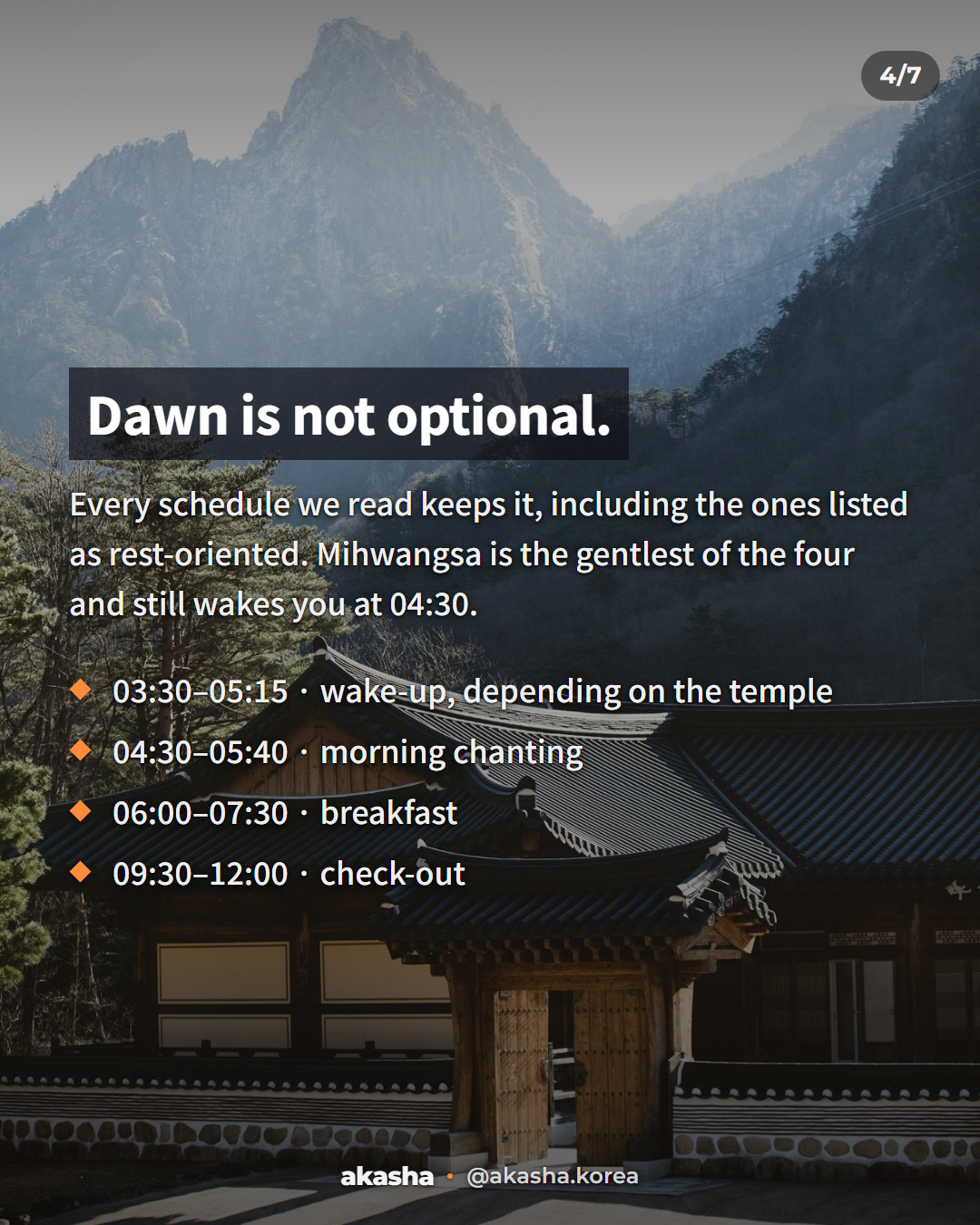
Why is anyone awake at 4am?
The schedules give you the hour without the reason. Here is the reason, and I'll separate it clearly from what I actually experienced, because they're two different things.
The temple day doesn't start in the hall. It starts outside it, with a ritual called doryangseok. A monk walks a circuit of the grounds striking a moktak, the small wooden clapper held in one hand, chanting as he goes, before anyone gathers for the service. The Academy of Korean Studies' encyclopedia gives the stated purpose: to purify the grounds, and to wake heaven, earth and all sleeping beings out of delusion. Buddhist-press accounts put the usual start at around three in the morning, though some temples begin closer to four or five.
The striking is graded on purpose. It begins soft and low and grows louder and higher as the monk comes around, so that the temple wakes in stages instead of all at once. A silence rule is attached to exactly this window: from doryangseok until the dawn service finishes, you're expected to say nothing. That's narrower than the general "noble silence" request the program pages make of guests, and easier to keep.
Near the end of that circuit come the four instruments, usually hanging together in the bell pavilion: the bronze bell (beomjong), the dharma drum (beopgo), the wooden fish (mokeo) and the cloud-shaped gong (unpan). Each is said to reach a different class of beings, one for those on the earth, one for creatures born on land, one for those in water, one for creatures of the air. The order they're struck in is not standardised; Buddhist sources disagree, and it can differ between the dawn and evening service at the same temple. If you want to hear that instrumentation up close on a schedule rather than by chance, Beopjusa's evening block at 18:30–18:45 is a sound meditation with the dharma drums.
Now the arithmetic nobody puts on the booking page. Sunrise in Seoul in the second half of October falls around 6:42 to 6:52, and the first hint of light comes roughly half an hour before that. So a service at 4:30 or 5:00 in late October is not "early morning" in any sense your body recognises. It happens about two hours before the sky does anything at all.
Which brings me back to my phone. I can't tell you whether the moktak ever went past my room, because when the hour came I was already awake on an alarm I'd set myself. What I can tell you is that nobody came to get me. Beomeosa's schedule is honest about that possibility in writing: its 03:30–04:50 block is labelled individual wake-up, and the service after it is tagged optional.
So here's my advice: set your own alarm, and set it before you know whether you'll need it. Not because temples are unreliable, but because a 4am in an unfamiliar building is a bad place to be improvising, and the alarm is the one part of the morning that's entirely under your control. Fifteen minutes before the listed wake-up is enough.
Akasha Note Set the alarm and lay out your layers before lights-out, not after. The lights go off at nine or ten, and if you leave your clothes in a bag you'll be sorting them out in the dark, in a room where somebody else is still asleep.
Do you have to bow along?
Short answer from my own mornings: I bowed. Not from the side of the hall, not as a spectator taking notes. I followed what the room was doing.
Two things make that less frightening than it sounds.
The first is that the bowing built into the service is short. The Jogye Order's own English page describes yebul, the chanted service, as a ceremony of five fragrances: it opens with a Verse of Tea, then a Verse of Five Scents offering up the five virtues (precepts, concentration, wisdom, liberation, and the knowledge of liberation), then an incense mantra, then what the same page calls the Ritual of Seven Prostrations. Seven, known in Korean as chiljeongnye. That is a different thing entirely from the 108 prostrations, which appear as their own separate block on some schedules, such as Beopjusa's 05:00–05:40.
The second is that you're meant to follow rather than know. Guidance repeated across Buddhist sources is simply to stand when the monastics stand and sit when they sit, and to watch the officiating monk or the templestay staff if a movement is unfamiliar. I'd rather be straight with you here: the official etiquette page returned an error every time I tried to open it, so treat that as widely repeated practice, not as a line I can quote from the source.
There's one usable record of how this goes for foreign visitors, and it comes from the government's own news service. On 3 May 2025, fifteen international reporters on a templestay at Baekyangsa in South Jeolla attended the 4:20am service. Monks prostrated to the sound of the moktak, and the piece states it plainly: the reporters followed each movement.
What I remember is not the chanting. It's that the hall was cold.
Sitting still before dawn is a different proposition from walking there, and the service doesn't hurry. I won't tell you the hall was unheated, because I don't know how it was heated or whether it was at all, and no official page I could find says either way. I only know I was cold in it, and that of everything I could describe about those mornings, the cold is what lasted. I also can't tie my stays to one season, so take it as something that happened to me and not as a rule about October.
Which turns "bring layers," the dullest line on every packing list, into the useful one. Wear the extra layer into the hall, not just on the way over. The walk is short. The sitting still is not.
Send this to whoever you're going with.
What can you actually skip?
This is where the internet gets it wrong most often.
108 prostrations are not universal. Beopjusa schedules them at 05:00–05:40 on day two. Hwagyesa's overnight program has you making 108 beads, not bowing 108 times. Mihwangsa's rest program has neither. Golgulsa marks its 17:40–18:00 "108 Prostrations" slot explicitly optional.
Some temples mark the dawn service optional. Beomeosa does. Its 04:30–05:30 morning ceremony carries an "optional" tag, and the slot before it is individual wake-up rather than a group one.
But the early hour survives the rest-oriented label. Mihwangsa is the gentlest of the four, with no prostrations, no meditation blocks and whole afternoons marked "personal time," and it still wakes you at 04:30 for a 05:00 prayer. Booking rest-oriented removes activities. It does not move the sun.
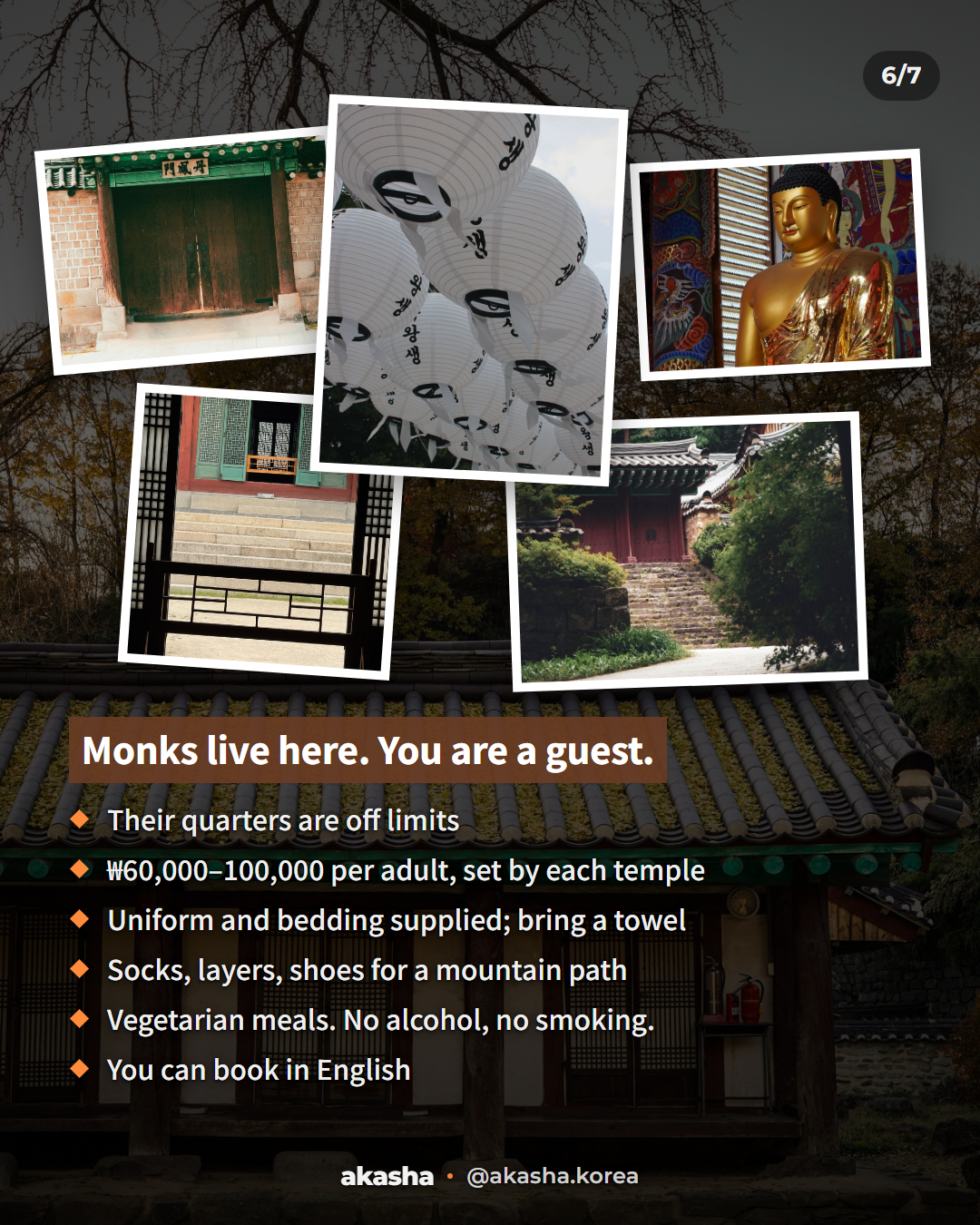
Two things run through every page I read: noble silence is requested for the whole stay (Hwagyesa words it "please keep the noble silent during your stay"), and the monks' quarters are off limits. People live here. You're a guest in their week, not a ticket holder at an attraction.
What it costs, and what goes in the bag
Listed 2026 prices for one night, per adult: Hwagyesa ₩90,000; Beomeosa ₩100,000; Beopjusa ₩100,000; Mihwangsa ₩100,000, or ₩80,000 for teens and children. The Seoul city government's English visitor page lists Jingwansa at ₩70,000 and Geumsunsa at ₩60,000. That page carries no last-updated date, so read those as the low end rather than a live quote.
Put together: roughly ₩60,000–100,000 per adult per night, priced temple by temple and program by program. There is no national rate, and anyone quoting you one is guessing.
Provided: the templestay uniform, usually a vest and trousers, and bedding. Beomeosa, Beopjusa, Golgulsa, Musangsa and the Lotus Lantern center all list some version of this.
Bring: toiletries and a towel (the Lotus Lantern page states soap and shampoo are not supplied), shoes for a mountain path, socks, layers, rain gear, a tumbler, prescription medication.
On every official page I checked: no alcohol, no smoking, vegetarian meals. Mihwangsa goes further and bars bringing meat or non-vegetarian food in at all, with eating restricted to designated areas. Shoes come off for rooms and halls, and socks are expected in ceremonies. Bongeunsa requires them in the tea room, and the Lotus Lantern rules forbid going barefoot. Dress modestly: Hwagyesa asks for modest clothing and no colorful makeup, Beopjusa bars sleeveless shirts and flip-flops.
Do it with a local A templestay is booked through the official Templestay site and nowhere else. The rest of the weekend is the part that's easier with someone who lives here: the temple-food lunch after check-out, the mountain trail you didn't plan for, the sound-meditation or walking meetup back in the city. Akasha, an app for finding local meetups and experiences in Korea, is where those are listed, alongside trips from registered Korean travel companies. Browse what's on near the temple you booked: iOS / Android
Words you'll actually hear
Two of these have a spelling I could confirm on an official English page, so those are the two I'll hand you with confidence.
- yebul: the chanted service, held in the evening and again before dawn. It is the fixed point of the day in every schedule above.
- barugongyang: the formal monastic meal, eaten from a nested set of wooden bowls called baru. Rice, soup, side dish and water, each in its own bowl. It is built so that nothing is left over. You eat what you took.
You will also hear sunim (how you address a monastic), Seon (Korean Zen meditation, the word on Beomeosa's 18:00 block), and hapjang, palms pressed together, which is the greeting. When in doubt, hapjang and a small bow will carry you through most situations.
One confusion worth heading off, since both words turn up in the same hour: the moktak is the small clapper carried in a monk's hand on the pre-dawn round, while the mokeo is the large wooden fish hanging in the bell pavilion. Same sound family, different instrument, different job.
A note on spelling. "Moktak" appears on Templestay's own webzine, so that one is first-party. Doryangseok and the four instrument names come from Korean Buddhist reference works and the Buddhist press, spelled consistently there but not written out in English on the Templestay site. If a monastic spells them differently to you, they're the one to follow.
If you're going for the autumn color
The Korea Forest Service's 2026 forecast puts peak foliage at Seoraksan on 20 October, Songnisan on 28 October, Naejangsan on 4 November and Hallasan on 6 November, with maple and oak turning nationwide around the end of October.
Line that up against the schedules and one match holds on both counts: Beopjusa, on Songnisan, peaking 28 October. Its weekend program already contains a 08:30–10:30 walking meditation up Sujeongbong peak or along King Sejo's road: a morning on the mountain, inside peak week, at a temple marked English-available.
Hwagyesa is worth noting for a different reason. It sits at the foot of Bukhansan inside Seoul, with a 07:20–08:30 Dullegil walk on the schedule. Bukhansan isn't one of the four forecast sites, so treat it as part of the nationwide late-October window rather than a dated peak.
Two honest gaps. Near Seoraksan, Baekdamsa and Sinheungsa both have official templestay temple pages, and Baekdamsa sits deep in Inner Seorak, but I couldn't open their program details, so I can't quote schedules or prices. For Naejangsan and Hallasan, the official English program search returned nothing the day I ran it. Programs may well exist; I'm not naming a temple I couldn't verify.
Who I'd tell not to book this
If your travel days start at 10am and end at 1am, one night here will feel like a punishment you paid for. Dinner at five and lights out at nine is not a quirky detail. It is the whole structure, and it does not bend.
If you want a spa weekend, this isn't it. Nothing is being done for you.
If silence makes you restless, note that noble silence is requested for the entire stay, not just during services.
And if you're travelling as a couple hoping for a romantic night away: accommodation is separated by gender, Mihwangsa's rules ask participants to avoid physical contact between genders, and Beopjusa's ask visitors to refrain from excessive displays of affection.
What's left, if none of that put you off, is one of the few things you can do in Korea that runs on somebody else's schedule entirely: a mountain, a bell at dusk, and a 4am hall with the lights on and a room full of people who came anyway.
Booking it
Everything with a time or a price on it came off the official Templestay site, which has an English booking and program-search page. Filter by type first, experience-oriented or rest-oriented, because that single choice changes your stay more than the temple does. Then check the English-availability marker on the individual temple page; it's set temple by temple, not nationally.
One note: the Templestay Information Center in Seoul was announced closed for fire restoration through the end of 2025, and I found no reopening notice. Don't plan on walking in.
Most of these temples sit outside the city, so you'll be on a train or an intercity bus to reach them. If you haven't sorted your fare card yet, I've written about which Korea transport card fits a first trip, and the three numbers worth saving before you land are the ones you'd want if a bus leaves without you.
If you're building the days either side of it, the Akasha app lists meetups, local tours and wellness experiences in one place, including trips from registered Korean travel companies.
One question before you go, and I do read the replies: did your temple wake you, or did you set an alarm like I did? Say which temple in the comments.
Who wrote this. I run Akasha and write this blog from Seoul. The templestay parts are mine — several temples, mountain and city. Akasha does not run or sell templestay programs; book through the official Templestay site. Facts checked 2026-09-23. More at @akasha.korea.