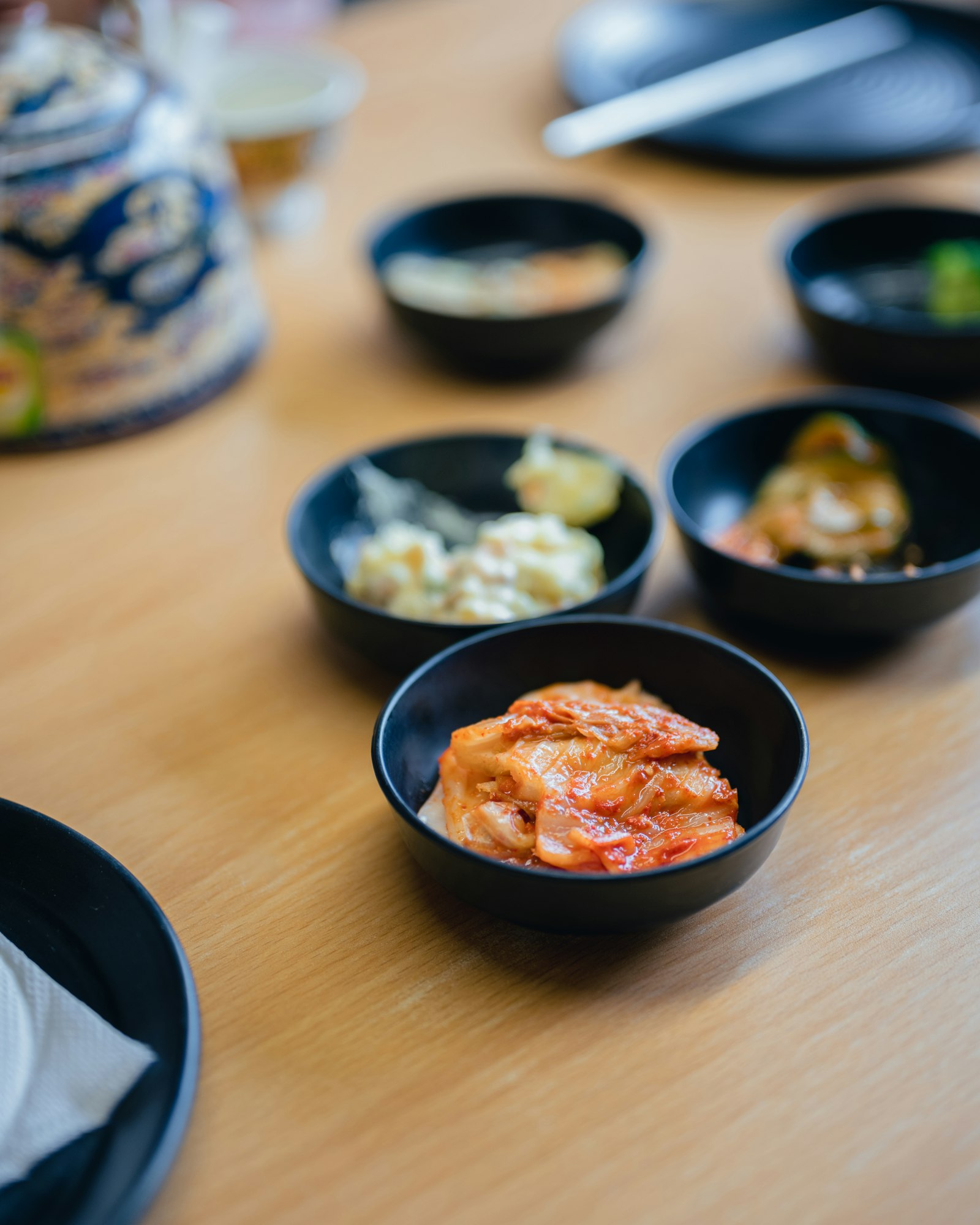
You sit down, you order one thing, and five or six small dishes arrive that you did not ask for. Kimchi, seasoned greens, something pickled, maybe a sheet of egg. These are 반찬, banchan, the small dishes that come beside the rice, and nothing about them is explained to you.
They are free. So is asking for more. When a dish runs out, catch the server's eye and say 저기요, then 이거 더 주세요.
What makes them interesting is the comparison. Three neighbouring countries put small dishes on your table in three different ways, and one of the three declines to charge you.
The same small dishes, three different bills
| Who chose it | Who pays for it | |
|---|---|---|
| Korea · 반찬, banchan | The kitchen. You did not order it | You don't. It is not on the bill |
| Japan · お通し, otoshi | The kitchen. You did not order it | You do. It functions partly as a cover charge |
| China · 凉菜, liangcai | You do. It is a menu category you order from | You do, as an ordered dish |
Japan's otoshi is the close comparison, because the mechanism looks identical from your seat: you sit down in an izakaya, a small dish appears, you did not ask for it. The difference is the bill. Japanese food writing describes otoshi as having taken on the character of a seat charge, typically a few hundred yen and occasionally over a thousand. In most izakaya it is not something you can decline.
China's liangcai sits in a different place entirely. Cold dishes are a category on the menu that you order from, alongside hot dishes and soups. At a banquet they come first, but that is a sequence inside a set meal you have already paid for.
So the Korean case is the odd one. Not ordered, and not charged.
Which ones are actually free?
There is no official list, and you do not need one. The test is the menu.
If a dish has a price printed beside it, it is food you ordered. A jjigae has a price, and so does a portion of cold noodles. Those are not banchan, and they were not part of the refill question.
If no price is printed beside it, it came with the meal, and you can ask for more of it.
That is the rule, and it holds where the two systems run side by side. A Korean barbecue place that hands you lettuce and kimchi without limit while charging separately for a stew is running both systems at once, and the menu tells you which is which.
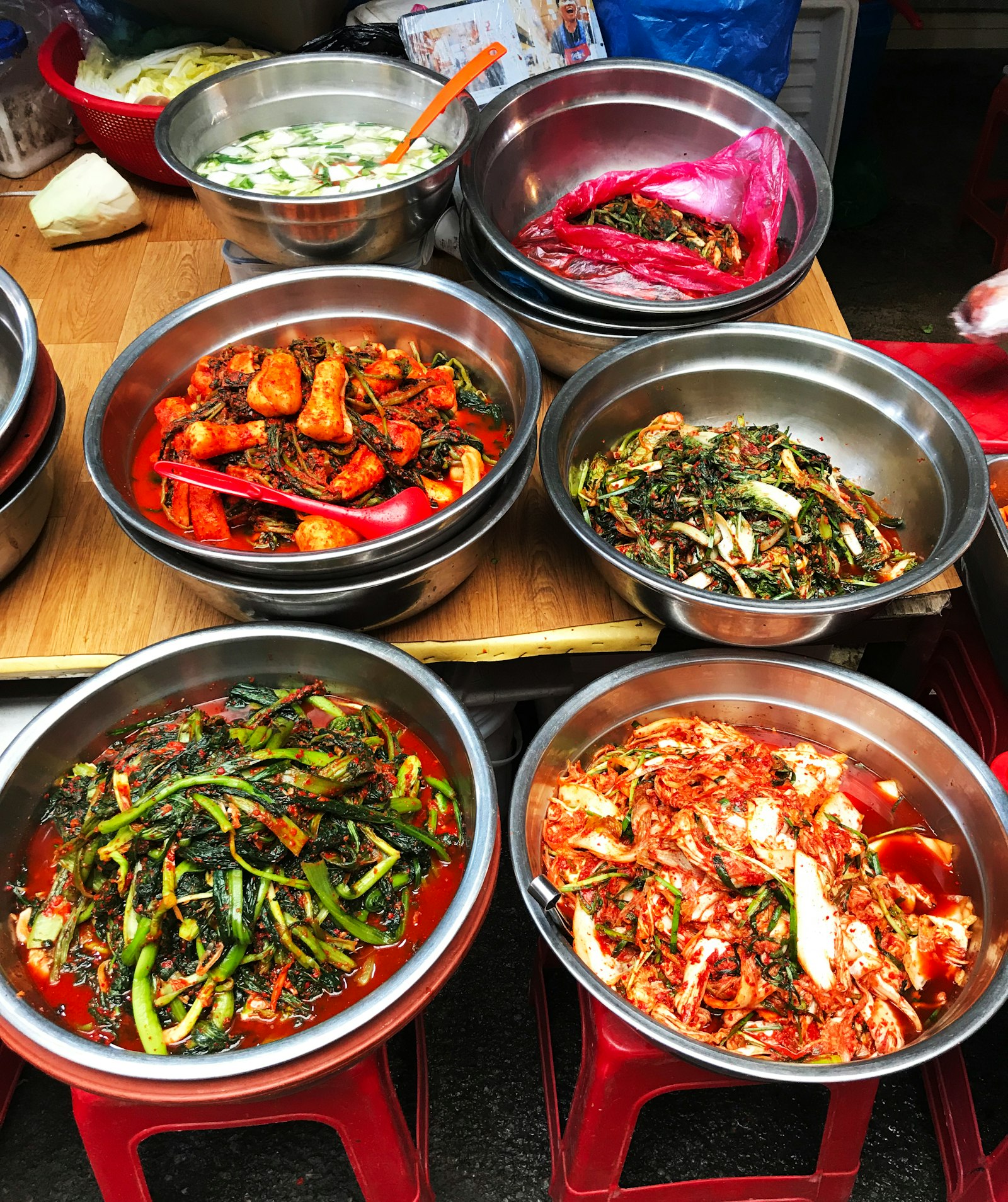
The refill is not generosity. It is a cost the kitchen absorbs
What you leave cannot be served to anyone else. Enforcement rules under the Food Sanitation Act, amended in 2009, prohibit reusing food a customer has left. The penalties run from a 15-day business suspension for a first offence up to revocation of the licence, and in serious cases to imprisonment of up to three years or a fine of up to 30 million won.
So the refill you ask for was bought, prepared and plated for you, and whatever you leave goes in the bin.
That reframes the polite move. Asking for more is ordinary and costs the kitchen the price of the ingredients. Taking a large refill and leaving most of it costs them the same and feeds nobody.
Korea has spent sixteen years nudging in the same direction. From around 2010 the government distributed small and compartmented serving dishes to restaurants, so that diners could take what they wanted instead of having a full spread laid out for them. Food waste has been charged by volume nationwide since June 2013.
2026 is the year the free part started to wobble
This has been true for decades. It is being argued about now.
In a February 2026 poll of restaurant owners, 38.5% supported charging for banchan refills and 61.5% did not. The owners arguing for a charge pointed at what had become expensive: lettuce, cheongyang chillies, mushrooms, gim, anchovies and squid.
Diners are against a blanket charge. In a survey of 1,000 adults aged 19 to 69, conducted 24–27 February 2026, 64.8% said they disliked the idea of paying for refills, and 42.3% said they would stop going to a regular haunt that introduced one. In the same survey, 53.3% could accept a compromise where basic banchan stays free and more expensive dishes carry a charge.
Two things are worth keeping straight here. Nothing has been decided, and neither the coverage nor the survey designates which dishes would carry a charge.
My advice, if you are reading this in a year when something has changed: look at where the line gets drawn rather than at the price. Somebody will have to write down which dishes count as basic, and that is the part nobody has done. What the survey does show is that the line between "basic" and "premium" side dishes is one people already feel.
How to ask
You need two moves: get someone's attention, then point.
저기요, jeogiyo, is the standard way to call a stranger in Korea. The National Institute of the Korean Language surveyed 4,000 people in 2017 and found it the most common choice at 62.5%.
Then either point at the empty dish and say 이거 더 주세요, igeo deo juseyo, "more of this please." Or name the dish: 김치 좀 더 주세요, kimchi jom deo juseyo, where 좀 softens the ask.
Here, there is nothing rude about calling a server over.
The short version
- Banchan are free, and so are refills. Ask when a dish runs out
- The test is the menu. No price printed beside it means banchan. A priced dish is food you ordered
- Say 저기요, then 이거 더 주세요. Pointing is fine
- Take what you will finish. Leftovers cannot legally be reused, so a large refill you abandon goes in the bin
- In 2026 this is under discussion. Owners are split 38.5% to 61.5% on charging for refills
The limits of this article
The legal points come from the Korea Ministry of Government Legislation's plain-language service and were read on 28 September 2026. The 2026 figures come from Korean news coverage of a restaurant-owner poll and from an Embrain Trend Monitor survey, both from February 2026.
The comparison with Japan and China is built from Japanese and Chinese food writing rather than from statute in either country. I have not verified any pricing rule behind either.
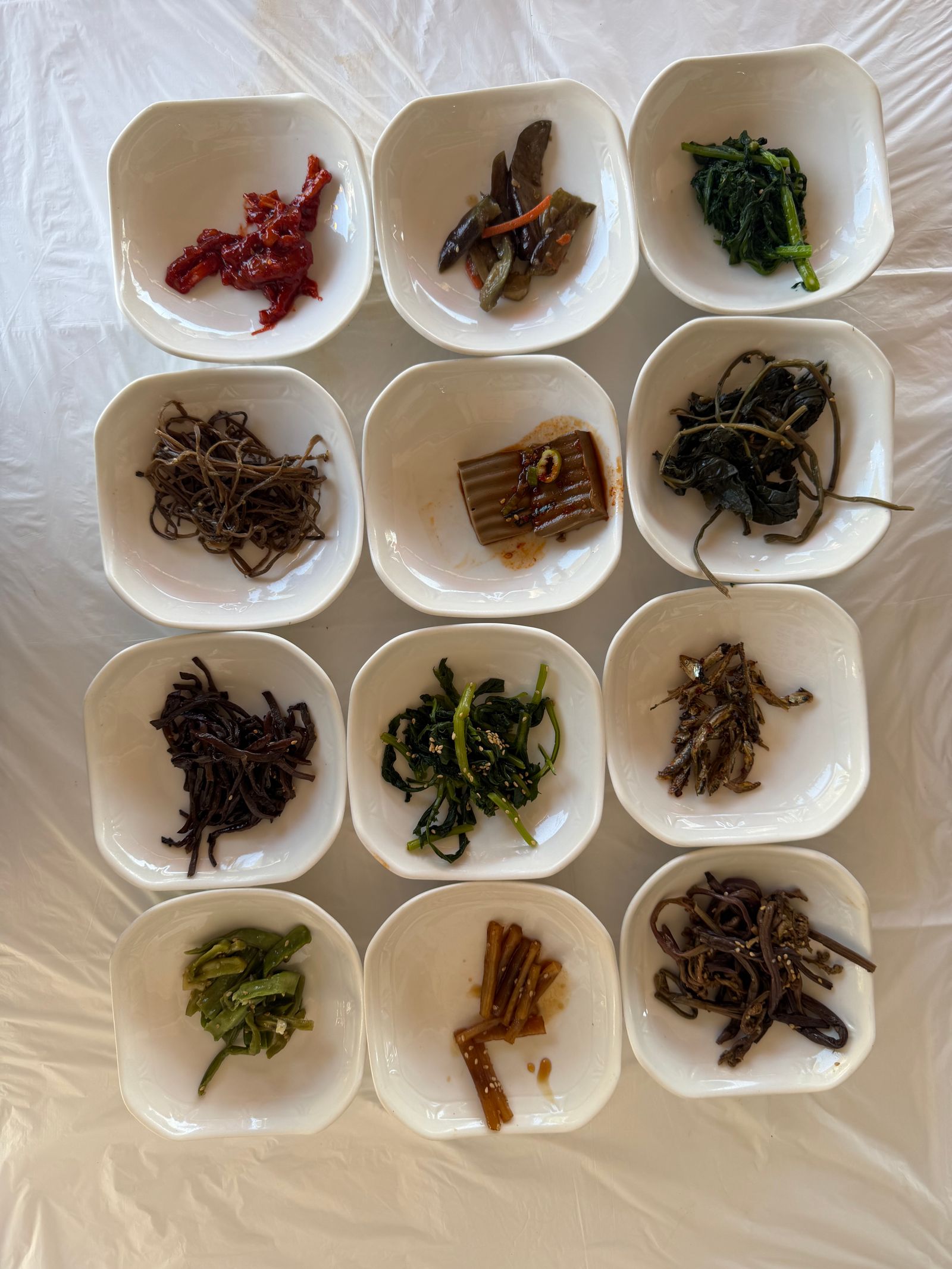
A Korean table is laid for the table rather than per person. The little dishes are the part you are not charged for. Asking for another round of the one you liked is an ordinary thing to do.
So ask. Then finish what arrives.
This works better with more than one of you. If you are eating alone, the seat I take when I am by myself covers the version of this that nobody writes about, and the rules at a Korean BBQ table are where the lettuce and the kimchi turn up again.
Do it with a local Akasha, an app for finding local meetups and experiences in Korea, is where people list what's happening nearby on the day you're actually free, sound baths to Sunday hikes, alongside trips from registered Korean travel companies: iOS / Android
One question for the comments, and I do read them: what was on your table that you could not identify?
Who wrote this. I run Akasha and write this blog from Seoul. I have not audited a restaurant's books; what I did was read the enforcement rules, the 2026 coverage and the survey, and check how the same custom is billed in Japan and China. More at @akasha.korea.
Sources
- Korea Ministry of Government Legislation, plain-language guide to the Food Sanitation Act on reusing food left by customers, including penalties: https://easylaw.go.kr/CSP/CnpClsMain.laf?popMenu=ov&csmSeq=302&ccfNo=4&cciNo=2&cnpClsNo=2 (read 2026-09-28)
- Money Today, restaurant-owner poll on charging for banchan refills, 2026-02-03: https://www.mt.co.kr/society/2026/02/03/2026020314551246993
- Asia Economy, coverage of the same debate and the cost items cited, 2026-02-03: https://view.asiae.co.kr/article/2026020309263707361
- Embrain Trend Monitor survey of 1,000 adults aged 19–69, 24–27 February 2026, reported 2026-03-25: https://www.mt.co.kr/society/2026/03/25/2026032510160140271
- National Institute of the Korean Language, 2017 survey of 4,000 people on forms of address: https://www.korean.go.kr/nkview/nklife/2018_1/28_0104.pdf
- Seoul Shinmun on the distribution of small and compartmented serving dishes to restaurants, 2010-03-29: https://www.seoul.co.kr/news/plan/2010/03/29/20100329028004
- Korea.kr policy briefing on volume-based food waste charging, nationwide from June 2013: https://www.korea.kr/archive/expDocView.do?docId=30822
- Otoshi as described in Japanese food writing: https://oggi.jp/6730028 · https://macaro-ni.jp/37219
- Cold dishes as a menu category in Chinese catering material: https://www.pengrenxiehui.cn/show.asp?id=152
Photographs are Unsplash and Pexels licensed works.