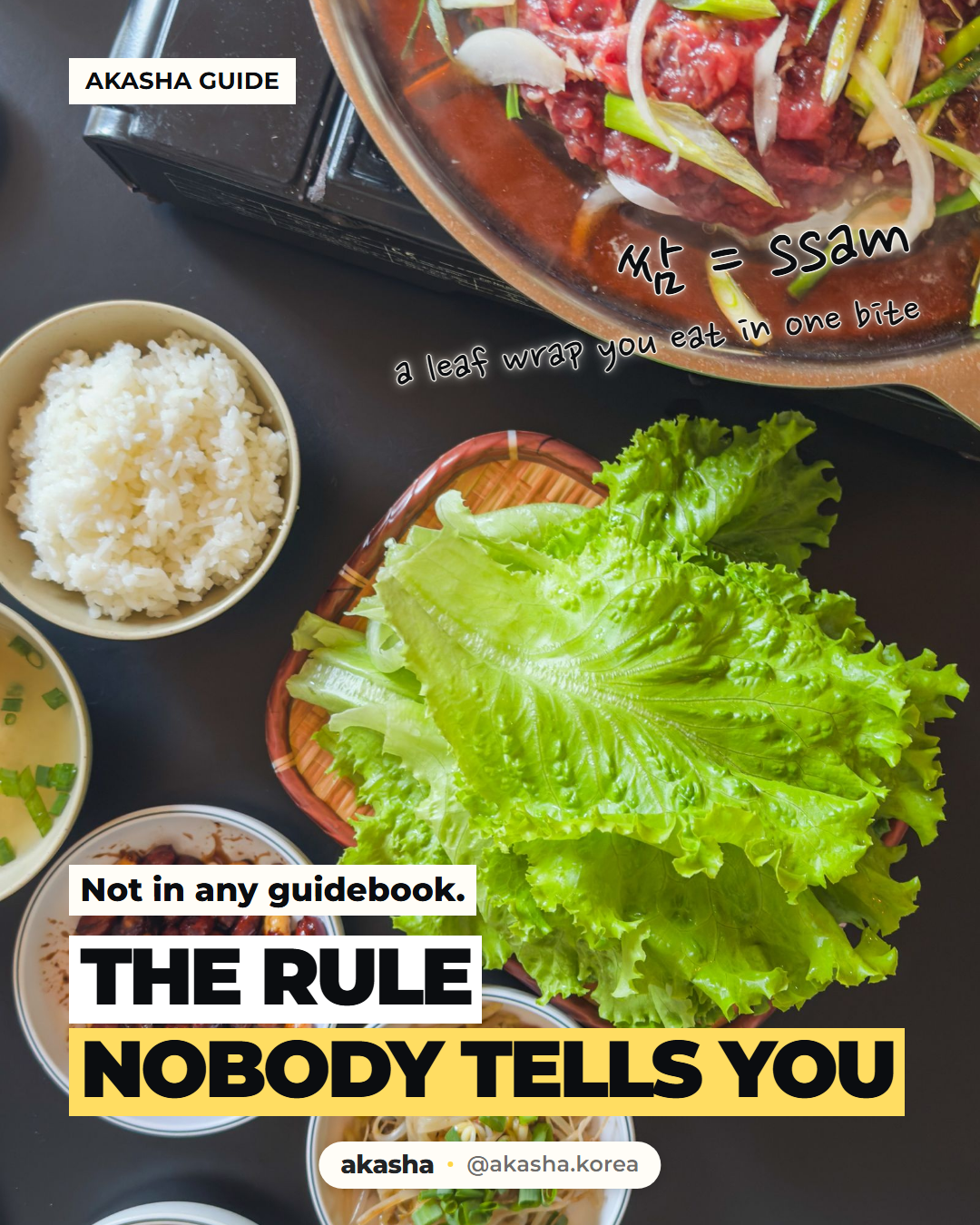
In Korean tradition the youngest person at the table grills the meat. At a grill house the meat arrives raw and the people at the table cook it themselves on a grill set into the middle of it, so somebody has to. That somebody will not be you. You are the visitor, you get treated as a guest, and the tongs stay on the far side of the grill.
Reach across and take them anyway. The tradition is thinning out, which is part of why the table will be surprised when you step into it, though the surprise is not really the point. Picking up the tongs is the difference between reading that a custom exists and standing inside it for five minutes.
Most etiquette advice written for visitors is defensive, a list of ways to avoid getting something wrong. This is the opposite kind of tip, and the fastest way I know to stop being a spectator at somebody else's dinner.
Who actually ends up doing the grilling?
December 2022, a company dinner, written up afterwards in a national daily. The meat lands and one of the employees is already turning it, without being asked and without thinking about it. Around the room the same job is being done at table after table, and at some of them it has been arranged in advance: somebody worked out who had three or more years of service and seated that person at each grill. None of this is announced. Nobody looks up.
Then one table of new hires sits down, eats, and touches nothing. That is the part that made the paper. For not doing something to become news, that something has to be fairly widely assumed.
At work the line is drawn by tenure rather than by birthday, which is what that seating was doing. Away from the office the same thing generally happens, at gatherings of friends and at family meals, and a table where everyone is much the same age is the case I like best: no clear ranking to fall back on, and somebody still tends to end up holding the tongs all evening.
The quietness is the strange part. Of fifty office workers asked about it in 2025, forty had watched the most junior person at the table leave the meat alone. Exactly one had ever said anything about it.
The arrangement has lost the argument, too. Asked in mid-2026 whether the lower-ranking person should be the one to handle the preparation for these dinners, three in four said no, a question that covered dinner preparation in general rather than grilling alone. A custom does not need anyone's approval to keep running. It needs only that nobody present wants to be the one who stops it. It is fading all the same, and that is part of why a visitor stepping into it registers at all.
Nobody hands a guest the tongs. Reach for them anyway.
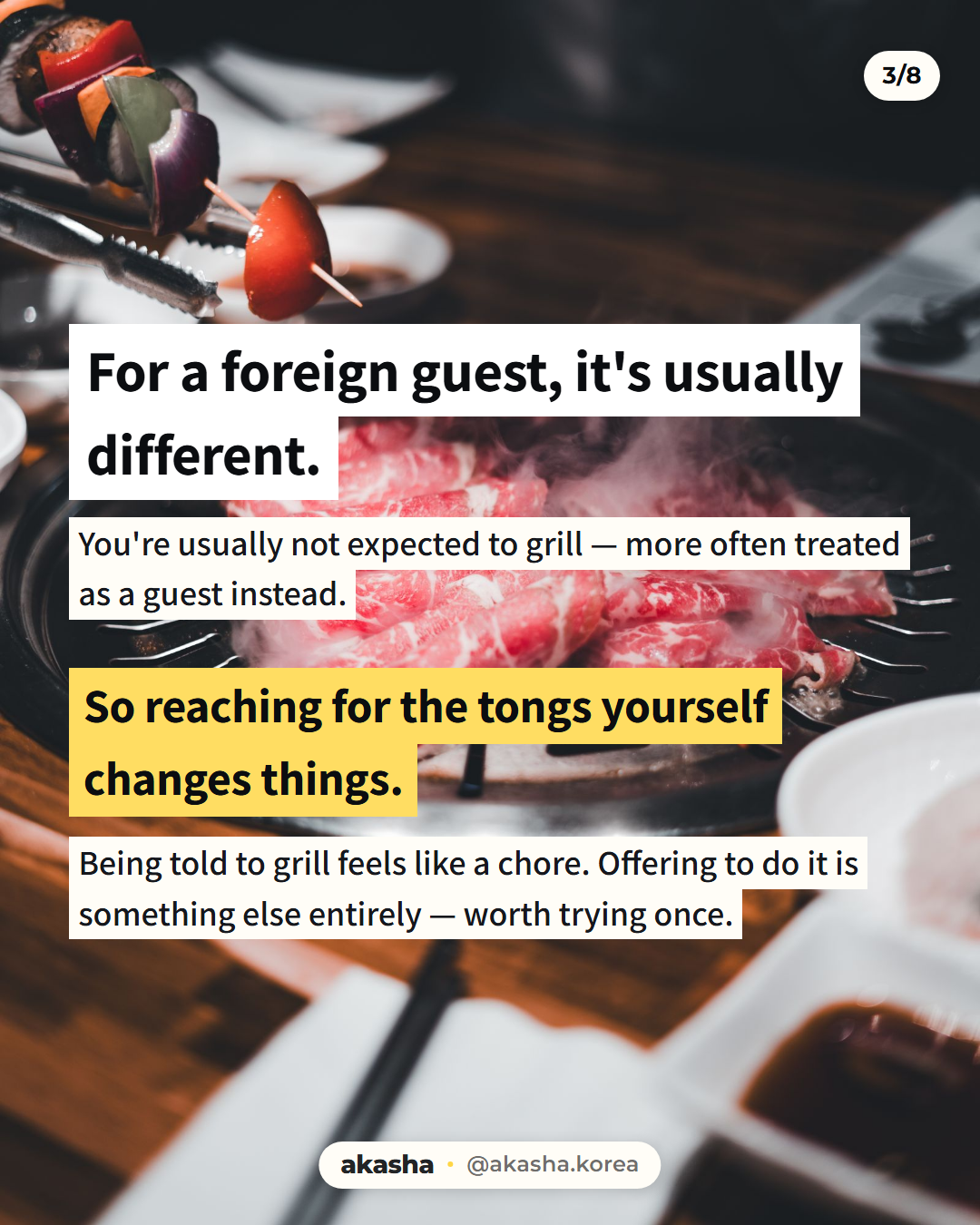
As a visitor you are generally left out of all of it. The grill gets managed around you, the tongs go back to the far side, and the whole negotiation finishes before you have worked out that one happened. You are a guest and the table treats you like one.
Which is what makes taking the job interesting. You were never in the queue for the tongs, so picking them up costs you nothing in the ranking that produced the queue, and you are doing the thing the table does by choice, having noticed it exists.
The job itself is small. Strips go on whole and stay there until they are cooked through, then they get cut down on the grill with the scissors already sitting on the table, into pieces small enough to share. That is the whole of it.
Nobody is going to ask you to do any of it. The choice is yours and it is a small one. Tongs in your hand, six strips of pork belly, five minutes.
Akasha Note Watch the first ten seconds after the raw meat lands. Somebody will move, and once you have seen who, you know where the tongs live for the rest of the meal. That is also your window: the offer reads as an offer at second ten, and as an interruption at minute five.
Send this to whoever you are going with, ideally before you are both sitting there watching one person do all the work.
Eating alone here is its own skill, with its own word, honbap, and its own strategy about which seat to take. This is the other direction: a table with other people at it, a grill in the middle, and one small job that nobody will hand you.
So take it. I'd wait for the meat to land, then reach across before anybody else does, and expect the table to be surprised. Then turn the pork, cut it down when it is ready, and let the evening go on around you. That part you cannot read about.
What a grill table needs is people around it. Akasha, an app for finding local meetups and experiences in Korea, is where you find them.

Who wrote this. I run Akasha and write this blog from Seoul. Akasha does not run or recommend restaurants. Facts checked 2026-09-26. More at @akasha.korea.