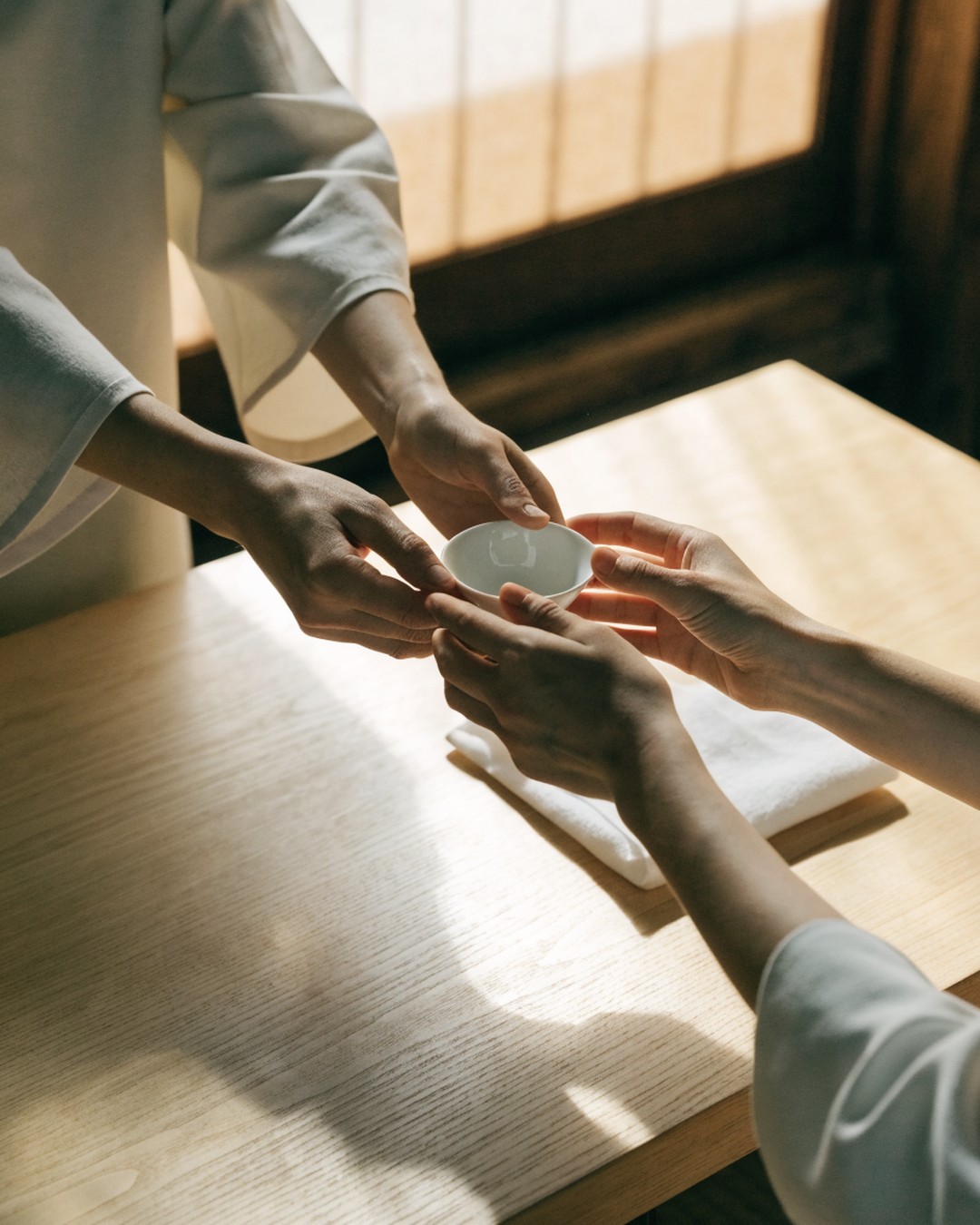
Before you pay for a Korean tea programme, ask it two questions: do I sit as a guest or practise as the host, and which rite does it teach. The word on the listing will be darye, and that word covers more than one thing.
Darye (다례) means the manners for brewing tea and offering it. The heritage listing for the court version puts it as the manners for brewing tea and offering it to a person, or to a god or a Buddha.
Two rites, one word
Korea has more than one darye. The court listing names the branches directly: alongside the rites of the court there are Confucian, Buddhist and Daoist ones. Separately from that list, two rites are designated as intangible heritage.
| Where it was done | Designated | What you would see | |
|---|---|---|---|
| 궁중다례 gungjung darye | The palace — lectures, royal occasions, receiving envoys | Seoul, 2001 | A cup moving between ranked people, standing |
| 규방다례 gyubang darye | The inner room of a scholar-official's household | Incheon, 2002 | A host receiving guests, seated, from the gate and back |
They are not two styles of one performance. The court rite covered several occasions — royal lectures, court events, and the reception of envoys. The household one is hospitality in a home.
The court version, in order
The Seoul listing describes the rite for receiving envoys, as practised by its designated holder. Read it as a seating plan first.
The king's chair faces east, against the west wall. The envoys' chairs face west, against the east wall. The incense table stands at the north wall. King and envoys bow to each other and sit.
Then the attendants come in. One carries the tea bottle, one carries the cups and their tray, and they stand to the west. Two more come with trays of fruit, one standing to the right of the senior envoy, one to the left of the deputy.
And then the cup starts moving.
- An officer takes a cup, kneels, and offers it to the king
- The king rises, steps forward, and carries the cup to the senior envoy
- The senior envoy receives it and passes it for the moment to an interpreter
- A second cup goes to the deputy envoy
- A third comes back to the senior envoy, who carries it to the king
- The interpreter hands the first cup back to the senior envoy
- The king sits and drinks
Count the hands. The king does not reach for his own cup, and neither does the senior envoy.
Then the officer kneels again to take the cup away, the fruit is offered standing to the envoys and kneeling to the king, and the trays go out.
What is on the table
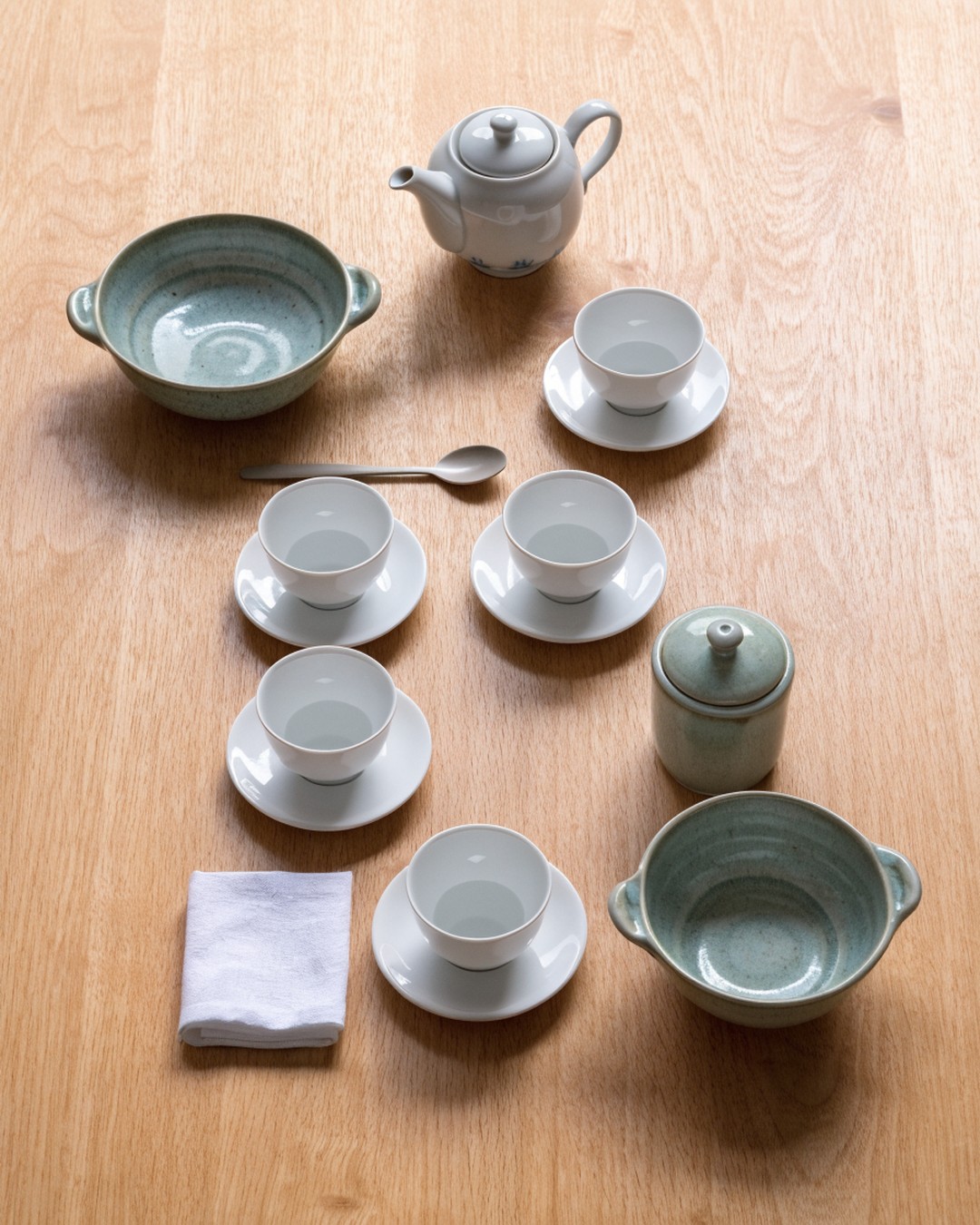
The listing also names utensils, and ends the list with 등, meaning and so on. Two of the bowls in it are not for drinking from.
| Korean | What it is for |
|---|---|
| 탕관 tanggwan | The kettle, for boiling the water |
| 차관 chagwan | The teapot |
| 찻잔 chatjan · 잔받침 | The cups and their saucers |
| 숙우 熟盂 sugu | A bowl whose job is to let the water cool. |
| 찻숟가락 · 차항아리 | The tea spoon and the tea jar |
| 차수건 · 차병 | The tea cloth and the tea bottle |
| 퇴수기 toesugi | The bowl that catches the used water |
The household version, gate to gate
The other one is the one you are more likely to sit in. The encyclopedia entry for 규방다례 describes it as the tea manners of women in scholar-official households, restored and set down as a form, and it starts further back than you would expect.
The host meets the guests at the front gate. They are shown to the inner room and greeted with a formal bow, then taken to the tea room and seated at the tea table. The host goes to where the utensils are and brews.
Then the order matters:
- The brewed tea goes onto a tray, and the cups are offered to the eldest guest first
- The host returns to the utensils, tastes first, and gives a small bow of the head — that is the signal that you may begin
- The host's daughter brings the sweets round
- The host prepares a second round, joins the table, and the talking starts
- When the talking is done, the utensils go back, and the host walks the guests out to the gate
If you are the guest, your job in that sequence is small and specific: wait for the bow. The procedure gives a gesture to watch for.
The entry adds why the order is the way it is — households taught daughters 봉제사 접빈객 bongjesa jeopbingaek, the duty of ancestral rites and of receiving guests, and tea was the highest thing you could offer a visitor.
It is a restored form
This part is worth knowing before you watch it.
The same encyclopedia entry, written by a museum curator (the encyclopedia notes that its entries carry their author's scholarly view rather than the institution's position), says the women's rite did not continue through the colonial period, which it attributes to the spread of Japanese tea practice. From the 1970s a tea-culture figure named Lee Gwi-rye restored and codified it, and Incheon designated the result in 2002.
So what is demonstrated today is a reconstruction, with a date on it. That does not make it less worth watching. It does mean that if someone tells you this is how it has always been done, unbroken, the entry does not support them.
Which one are you booking
Two questions sort it out, and you can ask both in a message before you pay.
Do I sit as a guest, or practise as the host? These are different afternoons, and the listing I read does not say which. As a guest you are received and your job is to notice things. As a host-in-training the session is a lesson rather than a reception.
Which rite does the programme teach? The court one and the household one are not the same thing. If the answer involves a gate, a seated table and an order by age, you are getting the household version. If it involves standing, ranks and a cup crossing the room, it is the court one.
One more, if the listing is vague: how long. The household rite is defined from the gate and back to the gate, and the walking out is part of the form rather than the end of it.
One Korea Tourism Organization listing I read glosses darye as traditional tea etiquette, and that programme bundles it with tea-making and a tasting of tea sweets. That is a reasonable shape for a first visit, as long as you know which of the two you just watched.
The short version
- Darye is the manners for brewing tea and offering it
- Two designated versions: the court rite (Seoul, 2001) and the household rite (Incheon, 2002)
- At court the cup is carried between people. The king does not pick up his own
- In the household rite the eldest guest is served first, and the host tastes before anyone else
- The go-ahead is a small bow of the head. Wait for it
- The household version is described as a restoration set down from the 1970s, and was designated in 2002
- Ask two things before you book: guest or host, and which of the two rites
The limits of this article
The court procedure here is the Seoul heritage listing's own description, and the household one comes from an encyclopedia entry whose publisher states that entries carry their author's view. I have not quoted article numbers.
What I have not done is sit through either one. This is a reading of two designations and a tourism listing, not a report from a tea room. How any particular programme runs, what it costs and how long it takes are not in those documents.
Korea has darye traditions beyond these two; the listing names Confucian, Buddhist and Daoist ones. I read the two that carry heritage designations. Read this as October 2026.
Book the household one if you have the afternoon. What stays with you is the moment you work out that the small bow was addressed to you.
The matching logic — who serves whom, and in what order — runs through a lot of eating here. Who grills at a Korean BBQ table is the same question with tongs, and why the side dishes keep coming is the same question with food.
Do it with a local Akasha, an app for finding local meetups and experiences in Korea, is where people list what's happening nearby on the day you're actually free, sound baths to Sunday hikes, alongside trips from registered Korean travel companies: iOS / Android

One question for the comments, and I do read them: which signal in a culture took you longest to learn to read?
Who wrote this. I run Akasha and write this blog from Seoul. The court procedure here comes from the Seoul heritage listing, read in October 2026, and the household one from the Encyclopedia of Korean Culture. More at @akasha.korea.
Sources
- Korea Heritage Service, National Heritage Portal — Seoul Intangible Heritage, 「궁중다례의식」 (designated 2001-12-20) — https://www.heritage.go.kr/heri/cul/culSelectDetail.do?ccbaCpno=2221100270000 (read 2026-09-30 and 2026-10-01)
- Encyclopedia of Korean Culture (Academy of Korean Studies), 「규방다례」 — https://encykorea.aks.ac.kr/Article/E0079898 (Incheon Intangible Heritage, designated 2002-12-23; entry written 2022, last revised 2025-04-21; the publisher notes entries carry their author's scholarly view)
- Korea Tourism Organization, VisitKorea (English) — Suncheon Traditional Wild Tea House, programme description glossing darye as traditional tea etiquette — https://english.visitkorea.or.kr/svc/whereToGo/locIntrdn/rgnContentsView.do?vcontsId=89977 (read 2026-09-30)
Images in this article are AI-generated and are not photographs of any particular place or programme. No venue is named.