You land at Incheon, clear immigration, and start looking for the counter that sells transit cards. Stop looking: nothing you can board at that airport needs one. Buy the card once you are in the city, at a GS25 or a CU, and bring won in cash to load it.
What you are really buying is a set of fare rules, and those rules only start paying you back once you are riding in town.
Nothing at Incheon needs the card
Search the airport's own facility directory for 교통카드 (gyotong-kadeu, transit card) or 티머니 (T-money) and it returns nothing at all. T-money's own page does list the staffed bus ticket office at Incheon among its sellers. You just have no use for one yet: there are two normal ways out of that airport and neither one asks for a card.
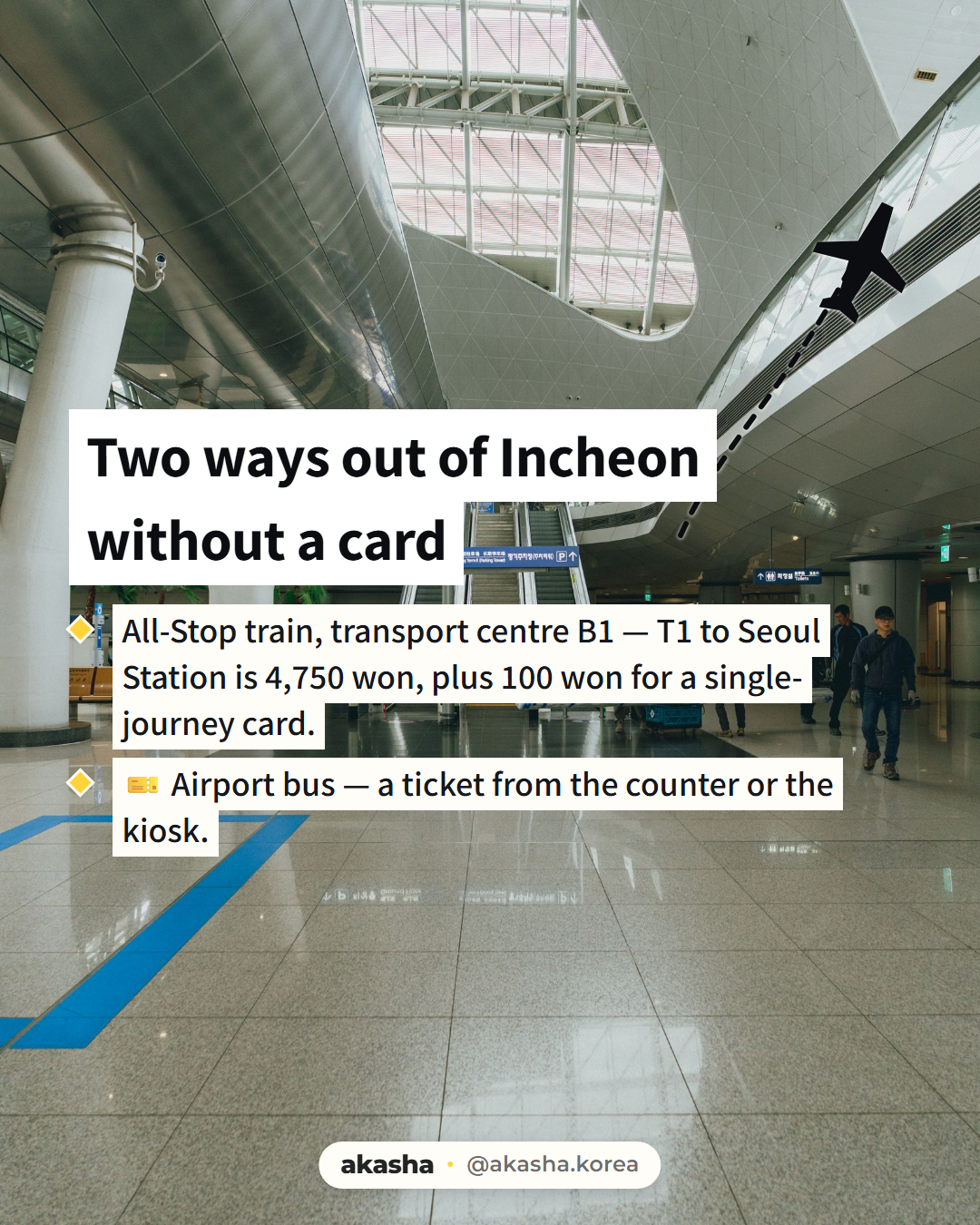
The airport railway's All-Stop train leaves from the transport centre on B1 at both terminals.
| From | To Seoul Station |
|---|---|
| Terminal 1 | 4,750 won |
| Terminal 2 | 5,350 won |
A single-journey card costs 100 won more than those fares, and you pay a 500-won deposit on top. Feed the card into a refund machine at the far end and the 500 won comes back.
Leaving Incheon, the airport bus does not take a tap at all. Airport Limousine says those departures are bought at the staffed counter or the kiosk, and Korea Airport Limousine calls them pre-purchase only. Going the other way, into the airport, T-money works fine on the same bus. That mismatch catches people who assume the ride works the same in both directions.
Seoul's Climate Card, the short-term pass visitors hear about most, covers the airport line only between Gimpo Airport and Seoul Station. You can get off at Incheon with it. You cannot get on.
What counts as 환승 · hwanseung
환승 · hwanseung means transfer: moving from one bus or train to the next. In Korea it is not a description of what you did. It is a condition you either meet or fail.
Seoul's transit feels frictionless, and the instinct is to credit the equipment: the frequent trains, the clean buses, the screen doors. But what makes a whole day of riding cheap is the fare design. A transfer and a re-entry are conditions, and you meet them with your card. Learn those two and the same trip costs you less than it costs the tourist standing next to you with the identical card.
Tap off on the bus too
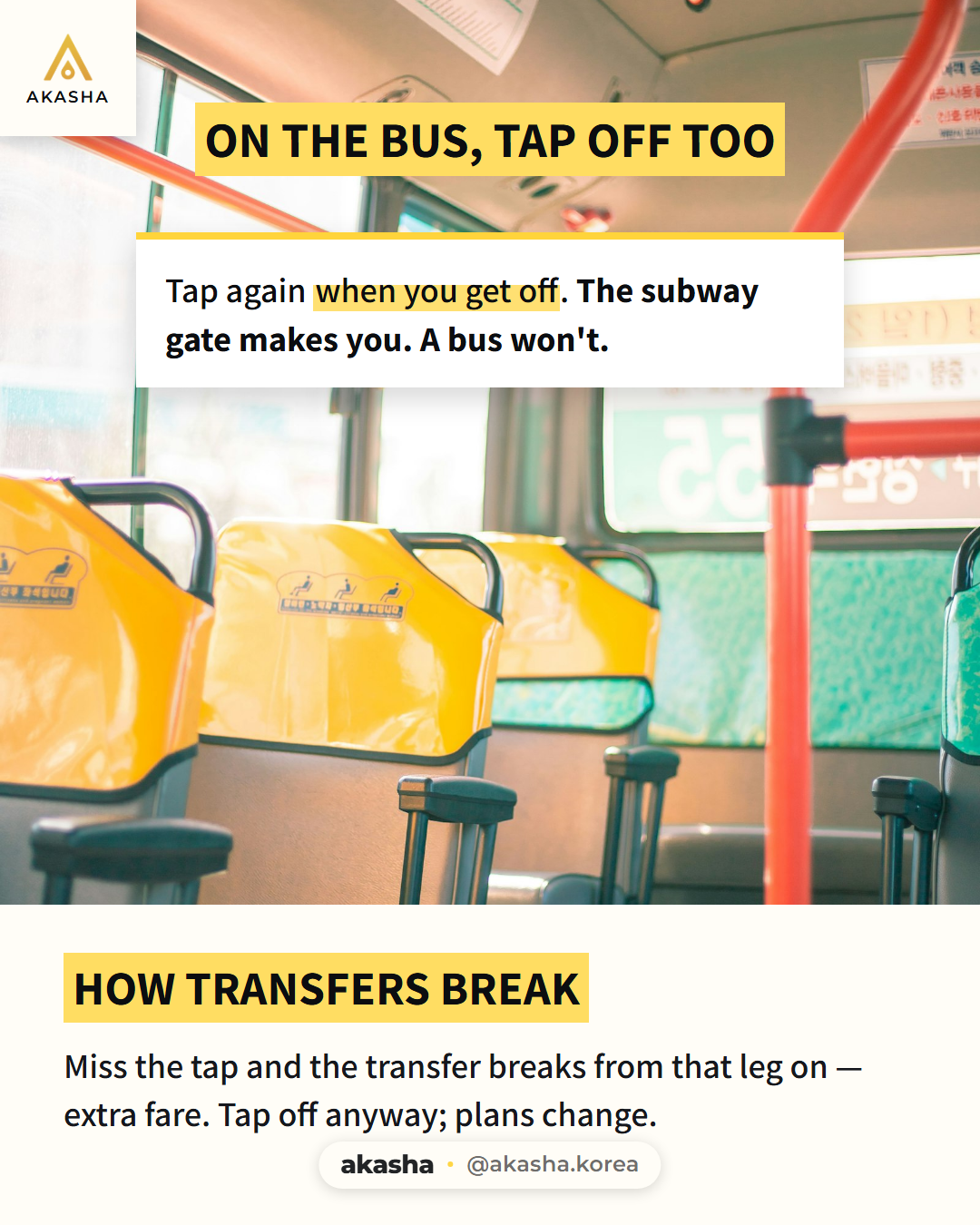
On the subway you cannot avoid tapping off, because the gate won't open. On a bus you can walk straight out of the back door, and plenty of people do.
Tap off even when you are certain the trip is over. Seoul's integrated transfer rules say the discount breaks from the untapped leg onward, so the next ride charges a fresh base fare instead of a transfer. Plans change, and a tap costs one second.
Two more limits come with it. There is a maximum of four transfers on one journey, which is five rides in total. And the transfer discount requires one card per person, so two travellers sharing one do not get it.
Three clocks decide your fare
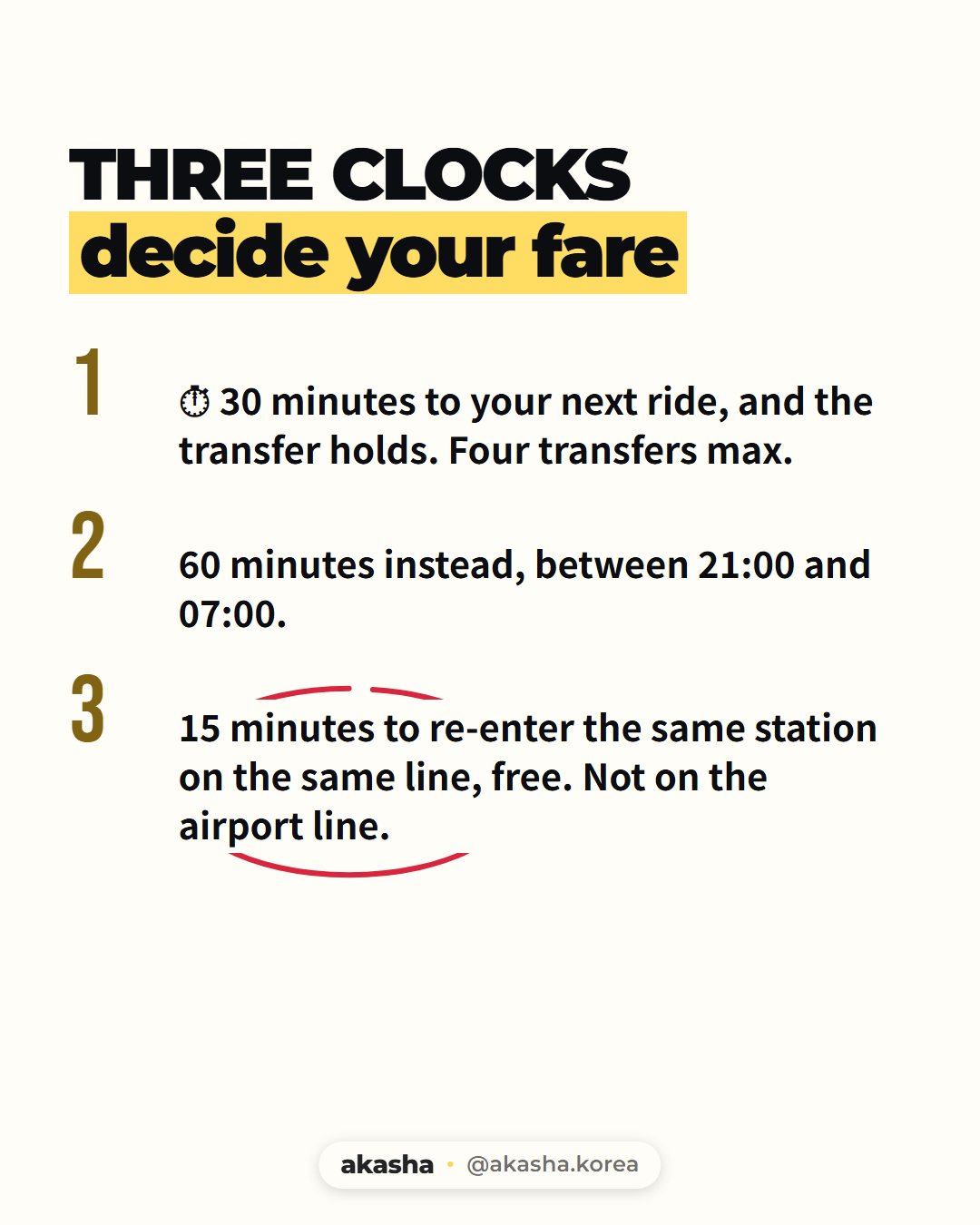
| Clock | How long | What it buys you |
|---|---|---|
| Transfer, daytime | 30 minutes | Tap off to tap on again and the transfer holds |
| Transfer, 21:00–07:00 | 60 minutes | A slow late connection still counts as a transfer |
| Re-entry | 15 minutes | Back into the same station on the same line, free. Once per journey |
Thirty minutes from tapping off to tapping on again, and the transfer holds. Between 21:00 and 07:00 you get sixty instead, so a slow connection that would have broken at noon still counts.
Go through the gate at the wrong station, or step out to a toilet on the concourse, and you have fifteen minutes to re-enter the same station on the same line without paying again.
It started at ten minutes in July 2023 and went to fifteen that October; in June 2026 it was extended to the Korail-run metropolitan lines. It works once per subway journey, and only on a prepaid or postpaid card, not a single-journey ticket.
The fifteen-minute rule is the one with a hole in it: it does not apply on the airport line, which is exactly where a first-time arrival is most likely to get off at the wrong station.
Where do you buy it?
T-money's visitor cards are the Travel Card at 4,000 won and the Travel Card Plus at 6,000 won. The operator says the Plus sits on the shelf at five convenience store chains: GS25, CU, Emart24, Storyway and 7-Eleven.
One card covers the subway, city buses, taxis, the airport railway and intercity coaches.
Topping up is cash. The official top-up guide lists convenience stores, station machines, street kiosks and partner ATMs, and the only plastic it accepts is a Woori Bank debit or credit card, at Woori ATMs and GS25. Land with no won and a wallet full of Visa, and you will be standing at the counter with nothing to load.
Since 17 March 2026, the new ticket machines at 273 stations on Seoul subway lines 1 to 8 take overseas-issued credit and debit cards, with an average 3.7% service fee. The list of what they will sell you is narrow.
| Your foreign card | Works? |
|---|---|
| Single-journey ticket, at the 273 new machines | Yes, since 17 March 2026, about 3.7% fee |
| Climate Card, same machines | Yes |
| Topping up an ordinary T-money card | No |
| Tapping straight onto the gate (open loop) | Not yet. Seoul city buses planned for 2027 |
That last row comes from T-money's September 2026 agreement with the international card networks. Read this as September 2026 and check before you rely on it.
On your way out of the country, walk into any convenience store and take the balance back in cash. They keep 500 won. The price of the card itself is not refundable.
Akasha Note Under a week and staying inside Seoul? Look at the Climate Card's short passes, which come in one-, two-, three-, five- and seven-day versions. The one-day pass is 5,000 won, and the longer ones work out cheaper per day. The physical card is 3,000 won on top, and the full price list and the excluded lines are on the city's page. Going anywhere outside the city, or arriving from Incheon, you want ordinary T-money instead.
Before you go
- Don't bother hunting for a card at Incheon. Take the All-Stop train with a single-journey card, or buy a bus ticket at the counter.
- Buy T-money at a convenience store in town. Travel Card 4,000 won, Travel Card Plus 6,000 won.
- Carry won in cash for top-ups. At the new station machines, foreign cards buy single-journey tickets and Climate Cards; ordinary T-money top-ups are not on the city's list.
- Tap off on buses, every time, even when you think the trip is over.
- One card per person. Share a card and the transfer discount doesn't apply.
- Thirty minutes between rides, sixty after 21:00. Re-entry is fifteen, and not on the airport line.
The rules are what you will still be using on your fourth trip. Send this to whoever is landing next week. If they get in late, the seat I take when I am eating alone tells them where to sit; the city wall is a good first morning once the card is in their hand.
One question for the comments, and I do read them: has anyone been charged a second base fare because they walked off a bus without tapping, and did you notice at the time?
Do it with a local Akasha, an app for finding local meetups and experiences in Korea, is where people list what's happening nearby on the day you're actually free, sound baths to Sunday hikes, alongside trips from registered Korean travel companies: iOS / Android

Who wrote this. I run Akasha and write this blog from Seoul. More at @akasha.korea.